

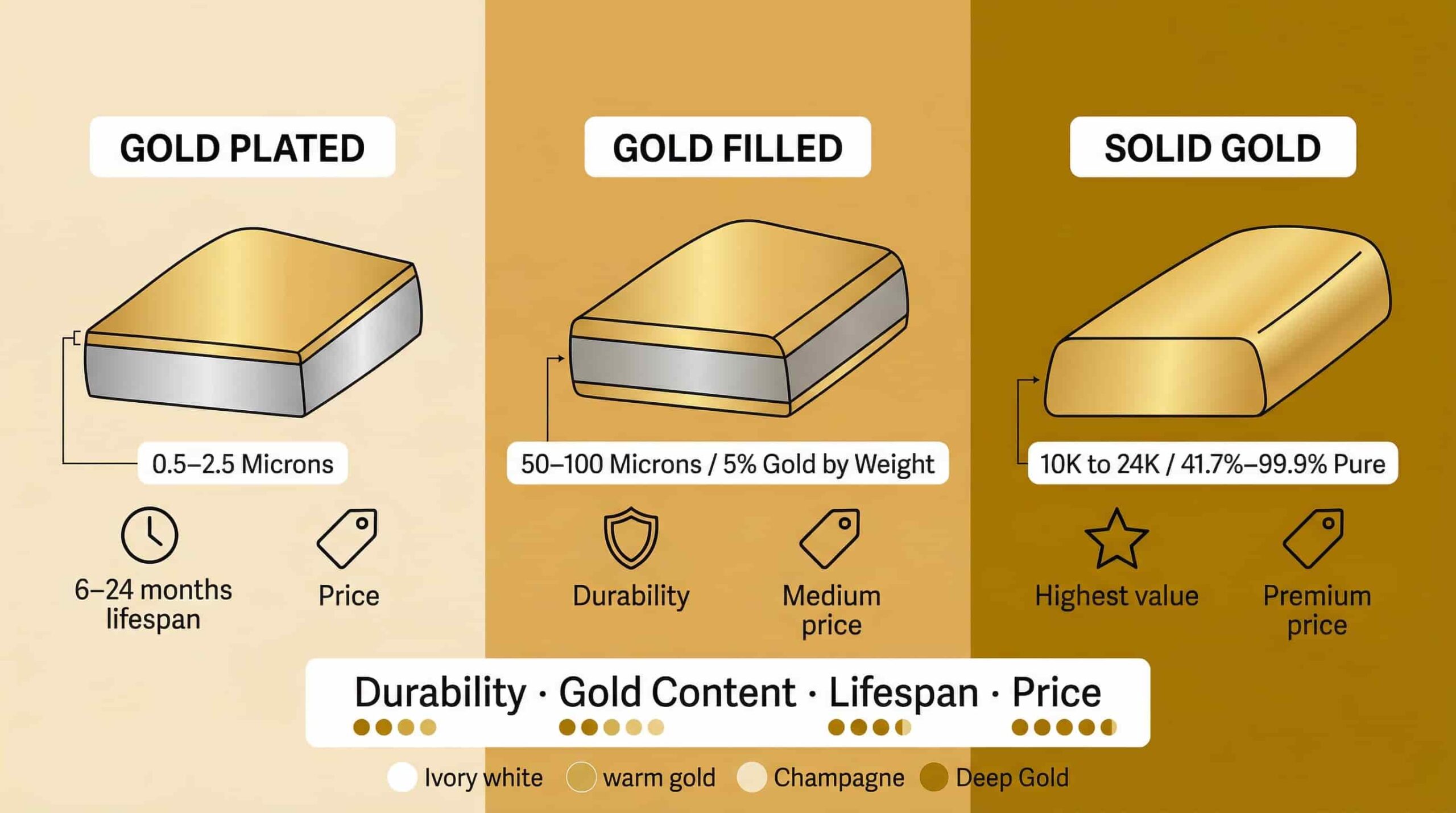
Gold plated, gold filled, and solid gold jewellery differ in gold content, layer thickness, durability, and price, three structurally distinct categories, not quality grades of the same material. Understanding these 3 types prevents costly purchasing errors, especially for bridal sets, engagement rings, and everyday wear.
What Is Gold Plated Jewellery?
Gold plated jewellery consists of a base metal, typically brass, copper, or 925 sterling silver, coated with a thin layer of gold measuring between 0.5 and 2.5 microns. The electroplating process bonds gold ions to the base metal surface using an electric current. The gold content in plated pieces is less than 0.05% of the item’s total weight.
Gold plated pieces, such as 18K gold plated sterling silver rings, bangles, and necklace sets, deliver the visual appearance of gold at a fraction of the cost of solid gold. Zuha Jewellery’s gold plated necklaces and bridal sets are crafted on a 925 sterling silver base, which provides a superior foundation for plating adhesion compared to brass.
How Long Does Gold Plating Last?
Gold plating lasts between 6 months and 2 years under daily wear conditions, depending on 3 primary factors: layer thickness, skin pH, and exposure to chemicals such as perfume, chlorine, and sweat. A 2.5-micron layer outlasts a 0.5-micron layer by approximately 18 months under identical conditions.
Gold plated jewellery tarnishes at the contact points first, specifically areas such as ring shanks, bracelet clasps, and necklace chains where friction is highest.
What Is Gold Filled Jewellery?
Gold filled jewellery contains a solid layer of gold that constitutes at least 5% of the item’s total weight by law, mechanically bonded under heat and pressure to a base metal core. The US Federal Trade Commission (FTC) mandates this 1/20 ratio for any piece marketed as “gold filled.” The gold layer in gold filled items measures between 50 and 100 microns, 20 to 40 times thicker than standard gold plating.
Gold filled pieces, including chains, cuffs, and hoop earrings, resist tarnishing for 10 to 30 years under normal wear. The mechanical bonding process makes the gold layer non-separable without industrial processes, unlike electroplated coatings which can flake with abrasion.
Gold Filled vs Gold Plated: 4 Key Differences
- Gold content: Gold filled holds 5% gold by weight; gold plated holds less than 0.05%.
- Layer thickness: Gold filled measures 50–100 microns; gold plated measures 0.5–2.5 microns.
- Durability: Gold filled lasts 10–30 years; gold plated lasts 6 months to 2 years.
- Tarnish resistance: Gold filled resists tarnish under daily wear; gold plated tarnishes at friction points within months.
What Is Solid Gold Jewellery?
Solid gold jewellery contains gold throughout the entire metal mass, with no base metal core, expressed in karats ranging from 10K (41.7% gold) to 24K (99.9% pure gold). The karat system, standardised internationally by hallmarking authorities including the Hallmarking Council of Pakistan and the UK’s Assay Office, quantifies the gold-to-alloy ratio in 24 equal parts.
Common solid gold alloys used in jewellery include:
- 10K gold — 41.7% gold, alloyed with silver, copper, and zinc; highest hardness in the solid gold category
- 14K gold — 58.3% gold; the most common karat for engagement rings and daily-wear jewellery in North America
- 18K gold — 75% gold; standard for fine jewellery, bridal sets, and high-end necklaces across South Asia and Europe
- 22K gold — 91.7% gold; traditional standard for Pakistani and Indian bridal jewellery
- 24K gold — 99.9% gold; used for gold bars, coins, and ceremonial pieces; too soft for most wearable jewellery
Solid gold jewellery carries intrinsic metal value that fluctuates with international gold spot prices. As documented in Zuha Jewellery’s guide on gold jewellery prices in Pakistan, 24K gold reached PKR 563,862 per tola in March 2026, a benchmark that directly determines the raw material cost of every solid gold piece.
Gold Plated vs Gold Filled vs Solid Gold: Side-by-Side Comparison
| Property | Gold Plated | Gold Filled | Solid Gold |
| Gold content | < 0.05% | ≥ 5% (1/20) | 41.7%–99.9% |
| Layer thickness | 0.5–2.5 microns | 50–100 microns | Entire piece |
| Lifespan (daily wear) | 6 months–2 years | 10–30 years | Indefinite |
| Tarnish resistance | Low | High | Very High |
| Resale value | None | Negligible | Significant |
| Price range (per gram) | Lowest | Moderate | Highest |
Which Type Suits Each Use Case?
The correct gold type depends on 3 factors: frequency of wear, budget, and whether resale value matters.
For Bridal and Wedding Jewellery
Solid gold at 18K or 22K karat delivers the highest durability and retains metal value — the standard choice for Pakistani bridal sets worn across multi-day wedding events. Gold plated 925 sterling silver bridal jewellery sets provide an accessible alternative with comparable aesthetics for nikah ceremonies and engagement events where the piece sees limited repeated wear.
For Everyday Jewellery
Gold filled pieces, specifically 14K or 18K gold filled chains, rings, and bracelets, represent the practical choice for daily wear, resisting sweat, water, and friction across 10+ years without replating. Gold plated sterling silver works for low-friction daily-wear items, such as earrings and pendants, where contact abrasion stays minimal.
For Fashion and Occasional Wear
Gold plated jewellery on a 925 sterling silver base, such as the pieces available in Zuha Jewellery’s rings and bangles collections, delivers maximum design variety and affordability for occasion-specific styling. Statement necklaces, cocktail rings, and layered chain sets worn 4 to 6 times per year retain their plating finish well beyond the 2-year average.
How to Identify Gold Type Before Buying
4 verification methods confirm the gold type of any jewellery piece before purchase:
- Hallmark inspection: Solid gold carries stamps such as 375 (9K), 585 (14K), 750 (18K), or 916 (22K). Gold filled pieces carry stamps like “1/20 14K GF.” Gold plated pieces show stamps such as “GP,” “GEP,” or the base metal hallmark alone (e.g., “925” for sterling silver).
- Acid test: A jeweller applies nitric acid to a small surface scratch; the colour reaction indicates gold purity — no reaction confirms solid gold above 14K.
- XRF spectrometry: X-ray fluorescence analysers measure exact elemental composition non-destructively, identifying gold content to within 0.1% accuracy.
- Magnet test: Gold is non-magnetic; a magnetic attraction indicates a ferrous base metal beneath plating, ruling out solid gold or high-quality gold filled construction.
As Zuha Jewellery’s guide on 8 things to check before ordering jewellery online confirms, verifying hallmarks and material certifications before purchase eliminates the most common sources of buyer dissatisfaction.
Gold Plated Jewellery Care: 5 Rules to Extend Lifespan
Proper storage and handling extend gold plated jewellery lifespan from 6 months to 2+ years:
- Store each piece in a separate airtight pouch to prevent inter-piece scratching.
- Apply perfume, hairspray, and lotions before putting on jewellery, not after.
- Remove plated jewellery before swimming, bathing, or exercise to prevent chemical and sweat degradation.
- Clean with a dry, lint-free microfibre cloth only, avoid ultrasonic cleaners and chemical polishes.
- Re-plate pieces through a professional electroplating service when tarnish becomes visible, typically at 12–24-month intervals.
Summary: 3 Facts That Determine the Right Choice
Gold type selection reduces to 3 measurable variables:
- Budget: Gold plated costs the least; solid gold costs the most; gold filled occupies the middle range at roughly 10–30% of solid gold prices.
- Wear frequency: Daily wear favours gold filled or solid gold; occasional wear suits gold plated on sterling silver.
- Value retention: Solid gold retains and appreciates in intrinsic value; gold filled and gold plated carry no significant resale value.
For bridal sets, necklaces, and rings across Pakistan’s jewellery market, 925 sterling silver with 18K gold plating delivers the optimal intersection of visual appeal, affordability, and durability for most buyers outside the solid gold price bracket.