

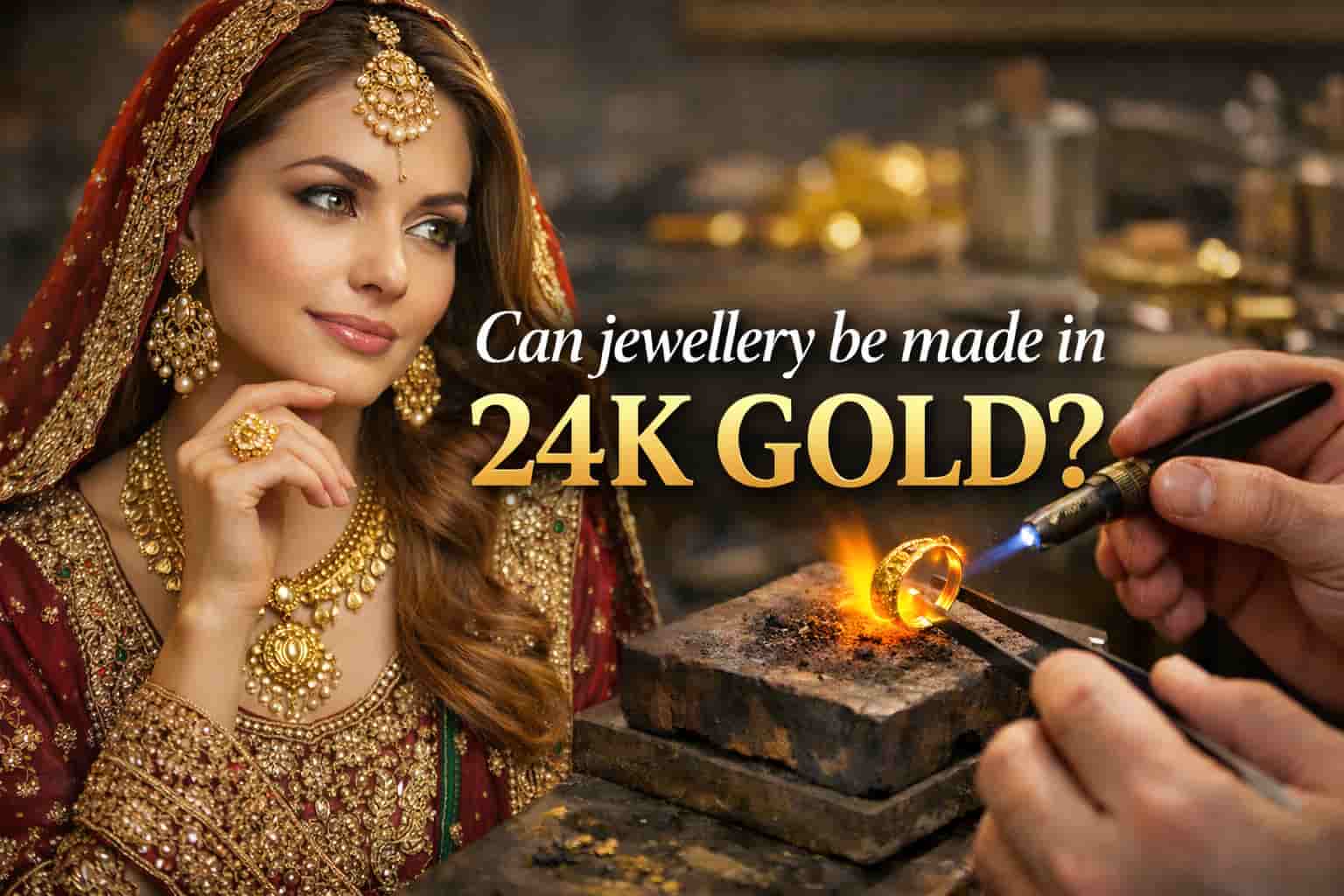
Jewellery can be made in 24K gold, and such pieces are produced commercially across multiple countries, including India, China, Thailand, and parts of the Middle East. However, 24K gold’s physical properties impose significant constraints on the types of jewellery it supports.
What Is 24K Gold?
24K gold is pure gold, containing 99.9% gold by mass with no alloyed base metals. The remaining 0.1% consists of trace impurities that cannot be refined away under standard commercial conditions. The World Gold Council classifies 24K as the highest purity grade available in retail and commercial jewellery markets.
Pure gold carries a Vickers hardness of approximately 25 HV, compared to 14K gold at 120–145 HV. This difference in hardness directly determines which jewellery forms are structurally viable. To understand how purity grades compare in practical retail contexts, see Types of Gold Used in Pakistan: 18K vs 21K vs 22K.
Why 24K Gold Presents Manufacturing Challenges
24K gold deforms under mechanical stress, which limits its application in jewellery that requires structural integrity or resistance to daily wear.
Key physical constraints include:
- Malleability: 24K gold can be hammered into sheets as thin as 0.1 micrometres without fracturing, making it prone to bending out of shape in wearable items.
- Softness: A Vickers hardness of 25 HV means fingernails, keys, and common surfaces scratch the metal.
- Low tensile strength: 24K gold has a tensile strength of approximately 120 MPa, compared to 725 MPa for stainless steel.
- Prong failure risk: Prongs set in 24K gold collapse under the pressure required to secure gemstones, including diamonds, sapphires, and rubies.
Jewellery forms that require tight tolerances, such as pavé settings, tension rings, and channel-set bands, are not structurally viable in 24K gold.
What Types of Jewellery Are Made in 24K Gold?
Specific jewellery categories are regularly produced in 24K gold, particularly where form, symbolism, or cultural tradition takes precedence over durability.
Traditional and Cultural Jewellery
In Indian jewellery traditions, 24K gold is used to produce specific ornament types: kundan jewellery, jadau necklaces, and temple jewellery worn during religious ceremonies. Thai Buddhist amulet cases, known as takrut holders, are also produced in 24K gold. These pieces are designed for occasional or ceremonial wear rather than daily use, which reduces exposure to mechanical stress.
Bullion Jewellery and Coins
Gold bullion coins and investment bars are struck in 24K gold by sovereign mints. The Canadian Maple Leaf coin, the American Buffalo coin, and the Chinese Panda coin are all produced at 99.99% purity. These items serve a dual purpose: wearable collectible and financial asset.
Gold Leaf and Decorative Applications
Gold leaf used in decorative jewellery is produced at 24K purity. Gold leaf sheets measure approximately 0.1 to 0.125 micrometres in thickness. Artisans apply gold leaf to lacquerware pendants, resin bangles, and ceramic brooches as a surface finish rather than a structural element. Zuha Jewellery’s Necklaces and Bangles collections feature gold-plated designs that deliver the visual depth of high-purity gold finishes on structurally resilient 925 sterling silver bases.
Wire and Granulation Work
Fine goldsmithing techniques, including granulation and filigree, use 24K gold wire for its superior workability. Granulation, a technique developed by ancient Etruscan and Sumerian craftsmen, relies on small spheres of high-purity gold fused to a base without solder. Because 24K gold flows and bonds at lower temperatures, it is preferred for this technique over alloyed alternatives.
How 24K Gold Compares to Other Purity Levels
| Purity | Karat | Gold Content | Hardness (HV) | Common Use |
| 99.9% | 24K | 99.9% | 25 | Bullion, ceremonial, granulation |
| 91.6% | 22K | 91.6% | 60–70 | Indian bridal jewellery |
| 75.0% | 18K | 75.0% | 130–180 | Fine jewellery, gemstone settings |
| 58.5% | 14K | 58.5% | 120–145 | Everyday western jewellery |
| 41.7% | 10K | 41.7% | 150–170 | Budget jewellery, clasps, findings |
18K and 22K gold dominate global fine jewellery production because their alloy content, typically copper, silver, palladium, or zinc, raises hardness without reducing visual appeal significantly. Buyers looking to understand how gold purity affects jewellery pricing in Pakistan can use the How to Calculate Gold Jewellery Price: Guide resource before making a purchase decision.
Countries Where 24K Gold Jewellery Is Common
24K gold jewellery is produced and purchased at high volumes in 4 primary markets.
- India: The Bureau of Indian Standards certifies 24K gold under the hallmark 999. Major production centres include Rajkot, Thrissur, and Kolkata. Bridal sets and temple ornaments dominate 24K output.
- China: The China Gold Association reports that 24K chuk kam (pure gold) jewellery accounts for a substantial share of domestic gold jewellery consumption. Retailers in Hong Kong and Shenzhen stock 24K chains, bangles, and pendants as standard inventory.
- Thailand: Thai goldsmithing guilds in Bangkok’s Yaowarat district produce 24K gold amulet cases and decorative chains sold to both domestic buyers and Southeast Asian export markets.
- Middle East: Jewellery souks in Dubai, Riyadh, and Doha stock 24K gold bangles and necklaces. The Dubai Multi Commodities Centre (DMCC) regulates purity standards for gold traded in the emirate.
Pakistani bridal traditions also place high cultural value on gold purity.
How Goldsmiths Work with 24K Gold
Goldsmiths adapt standard fabrication techniques when working with 24K gold to compensate for its low hardness.
The primary techniques used include:
- Repoussé and chasing: The goldsmith hammers 24K sheet from the reverse side to create raised designs, then refines detail from the front. This method exploits 24K gold’s exceptional malleability.
- Electroforming: An electrochemical process deposits 24K gold onto a mandrel to form hollow, lightweight pieces, such as large statement earrings and cuffs. The hollow structure reduces material cost and weight.
- Granulation: Etruscan-revival jewellers, including those working in the tradition of Castellani and Giuliano, apply pure gold granules fused by colloidal hard soldering or copper-salt bonding.
- Burnishing over stone: In kundan settings, a goldsmith presses 24K gold foil directly over a gemstone and burnishes it into place without mechanical prongs.
Each technique accounts for 24K gold’s tendency to deform under force by distributing stress across larger surface areas or eliminating stress-bearing structural elements entirely. Consumers seeking handcrafted pieces using gold-plated techniques on sterling silver can browse Bridal Sets and Earrings at Zuha Jewellery.
Practical Limitations for Everyday Wear
24K gold jewellery scratches, bends, and loses surface detail faster than alloyed gold jewellery under identical wear conditions.
Measured outcomes from comparative wear studies include:
- Surface scratches appear on 24K gold after contact with materials rated above 2.5 on the Mohs scale, materials that include common dust particles containing quartz (Mohs 7).
- Ring shanks in 24K gold deform measurably within 6 to 12 months of daily wear in occupations involving manual contact with hard surfaces.
- Prong tips on 24K gold settings deflect at loads as low as 5 newtons, insufficient to retain most faceted gemstones securely over time.
Jewellery intended for daily wear is more durable in 18K or 22K gold, which maintains visual warmth while delivering 5 to 7 times the hardness of 24K. Shoppers who want the appearance of gold for daily wear without structural compromise can explore Rings crafted in 925 sterling silver with gold plating, a category that combines durability with gold-tone aesthetics.
Authenticating gold jewellery before purchase is equally important. The guide on How to Identify Real Gold Jewellery in Pakistan details hallmarking, acid testing, and electronic verification methods used across Pakistani jewellery markets.
Summary
24K gold jewellery exists as a commercially produced, culturally significant, and technically viable product category, subject to application-specific constraints.
It is suitable for ceremonial ornaments, bullion pieces, decorative applications, granulation work, and markets where purity carries cultural premium value. It is not suitable for gemstone-set rings, everyday bangles subject to impact, or any jewellery form dependent on mechanical strength.
Goldsmiths in India, China, Thailand, and the Middle East continue producing 24K gold jewellery using techniques adapted to its physical properties, demonstrating that purity and wearability are reconcilable within defined parameters. Buyers in Pakistan seeking gold-aesthetic jewellery with everyday durability can explore Gold Jewellery Sets for Women for collections that balance traditional gold styling with modern material resilience.