

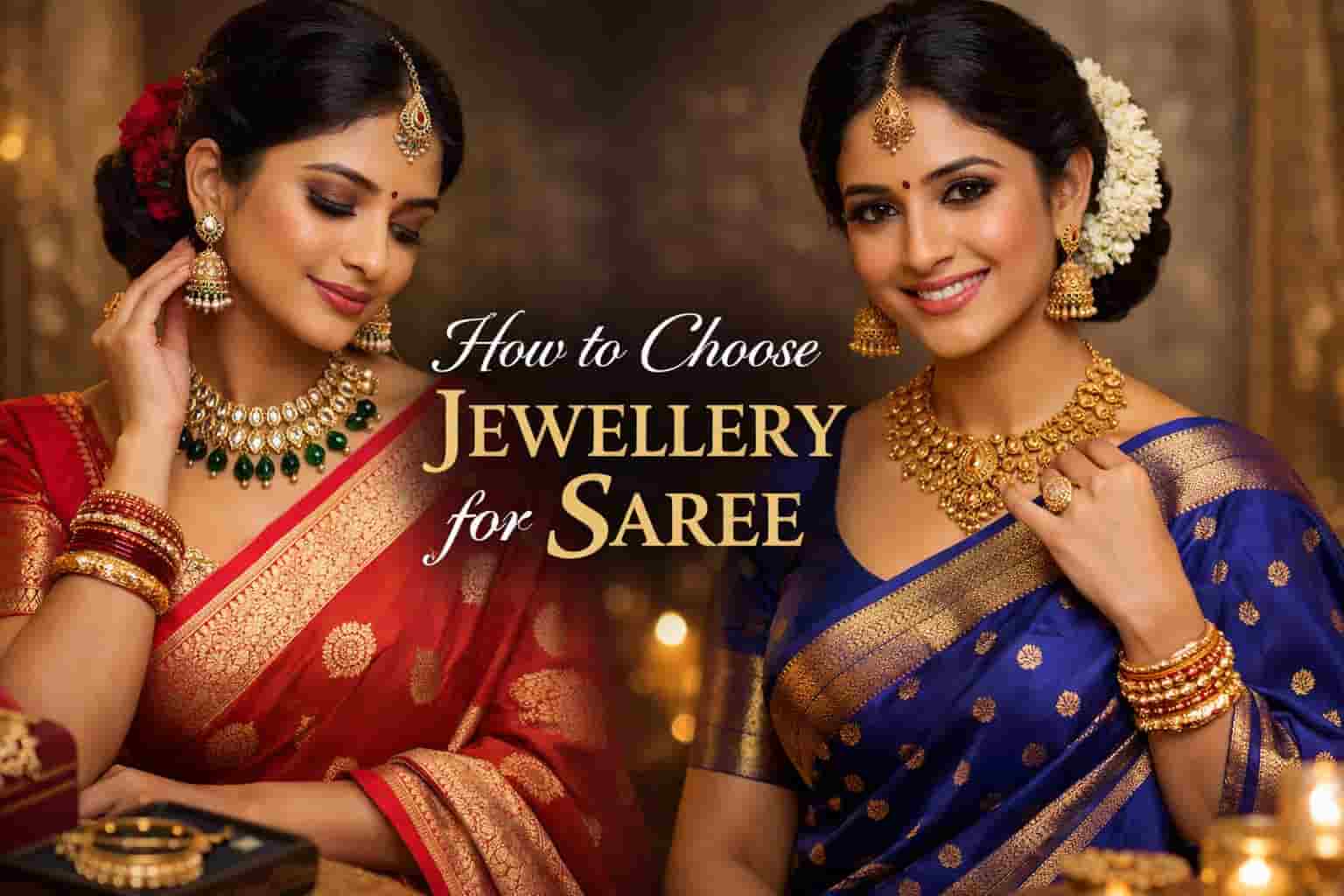
Matching jewellery to a saree requires alignment between the fabric weight, colour palette, embellishment density, and occasion formality. The selection process prioritizes neckline compatibility first, followed by colour coordination, metal tone matching, and proportional balance between the saree’s ornamentation and jewellery volume.
Understanding Saree Fabric and Jewellery Weight Compatibility
Heavy fabrics like Kanjeevaram silk, Banarasi brocade, and Paithani silk require substantial jewellery pieces weighing 40-80 grams per neckpiece. Lightweight fabrics including georgette, chiffon, and crepe complement delicate jewellery ranging from 15-30 grams. The fabric’s structural integrity determines the maximum jewellery weight the drape supports without distorting the pleats or pallu fall.
Silk varieties demonstrate specific jewellery affinities:
- Kanjeevaram silk pairs with temple jewellery featuring Lakshmi motifs and gopuram designs
- Banarasi silk coordinates with Kundan sets containing meenakari work and polki stones
- Tussar silk balances with oxidized silver jewellery incorporating tribal patterns
- Chanderi silk matches pearl jewellery using single-strand or layered configurations
Cotton sarees accept jewellery weights between 20-40 grams, positioning them between silk and synthetic fabric categories. The weave density influences this tolerance, handloom cotton withstands heavier pieces than mill-produced variants.
Neckline-Specific Jewellery Selection Criteria
The blouse neckline shape dictates necklace length, drop measurements, and design coverage area. Round necklines accommodate chokers measuring 12-14 inches with 2-3 inch vertical coverage. V-necklines require pendant necklaces dropping 6-8 inches below the collarbone to fill the triangular negative space. Boat necklines complement collar necklaces extending horizontally across the shoulder line without vertical drop.
Detailed Neckline Matching Framework
Sweetheart necklines pair with graduated necklaces featuring a central focal point positioned 3-4 inches below the neckline curve. Square necklines accept geometric jewellery designs, rectangular pendants, square-cut stones, and linear patterns that echo the angular silhouette. Halter necklines eliminate traditional necklaces entirely, shifting focus to statement earrings measuring 4-6 inches in length and cuff bracelets covering 3-5 inches of forearm width.
Off-shoulder blouses require choker-style necklaces sitting at the collarbone base, measuring 13-15 inches in circumference. Approximately 68% of saree wearers report improved aesthetic balance when necklace width matches blouse neckline width within a 2-inch variance.
Colour Coordination Principles for Saree and Jewellery
Monochromatic sarees accept contrasting jewellery in complementary metal tones, gold jewellery on navy blue sarees, silver pieces on maroon sarees, rose gold on emerald green sarees. Multicoloured sarees require jewellery incorporating stones matching 2-3 dominant saree colours. The colour wheel positioning determines harmony: analogous colours (adjacent on the wheel) create cohesive looks, while complementary colours (opposite positions) generate high-contrast drama.
Specific colour pairings include:
- Red sarees coordinate with emerald green stones, white pearls, or yellow gold settings
- Blue sarees balance with orange coral, white diamonds, or yellow topaz accents
- Green sarees match pink rubies, purple amethysts, or rose gold frameworks
- Yellow sarees complement purple tanzanite, blue sapphires, or white gold bases
Neutral-toned sarees (beige, cream, ivory, grey, black) accept jewellery in any colour family, providing maximum flexibility for gemstone selection. The absence of competing colour information allows focus on jewellery design complexity rather than chromatic matching.
Metal Selection Based on Skin Undertone and Saree Colour
Warm skin undertones (yellow, peachy, golden base) coordinate with yellow gold (22-24 karat), rose gold, and copper jewellery. Cool skin undertones (pink, red, bluish base) complement white gold, platinum, and silver pieces. Neutral undertones accept all metal varieties without chromatic clash.
The saree colour influences metal choice through temperature alignment:
- Warm-coloured sarees (red, orange, yellow, gold) pair with yellow gold and copper metals
- Cool-coloured sarees (blue, purple, green, silver) match white gold, platinum, and silver metals
- Jewel-toned sarees (ruby, sapphire, emerald) accept mixed metals in two-tone designs
- Pastel sarees coordinate with rose gold and brushed metals in matte finishes
Yellow gold reflects 45-55% of incident light, creating luminosity against darker saree colours. White gold and platinum reflect 65-75% of light, generating contrast against lighter fabric backgrounds.
Occasion-Based Jewellery Volume Guidelines
Wedding ceremonies require jewellery sets covering 5-7 body zones: neck, ears, forehead (maang tikka), nose, wrists (bangles), fingers (rings), and waist (kamarbandh). The combined jewellery weight ranges from 150-300 grams for bridal sarees. Corporate events limit jewellery to 2-3 zones (neck, ears, wrist) with total weight under 50 grams to maintain professional restraint.
Festival celebrations accept 4-5 jewellery zones with weights between 80-150 grams. Casual gatherings restrict jewellery to earrings and a single bracelet, totaling 20-35 grams. Religious ceremonies in temples require gold jewellery covering 6-8 body zones, reflecting traditional customs and cultural expectations.
Event-Specific Combinations
Morning events between 6 AM-12 PM coordinate with lighter jewellery pieces using pearl, coral, and pastel gemstones. Evening events after 6 PM accept heavier jewellery incorporating diamonds, rubies, emeralds, and sapphires that capture artificial lighting. Outdoor daytime events require jewellery with matte finishes to prevent excessive glare in sunlight exposure.
Embellishment Density Balance Between Saree and Jewellery
Heavily embellished sarees featuring zari work, sequins, mirror work, or stone embroidery pair with minimal jewellery limited to small studs and thin bangles. The saree’s ornamentation provides visual weight, eliminating need for competing jewellery volume. Plain sarees without embellishment require statement jewellery pieces to create focal points and visual interest.
The embellishment ratio follows an inverse relationship:
- 90-100% saree surface embellishment = 10-20% jewellery coverage
- 60-80% saree embellishment = 30-40% jewellery coverage
- 30-50% saree embellishment = 50-70% jewellery coverage
- 0-20% saree embellishment = 80-100% jewellery coverage
Border-heavy sarees with 4-8 inch borders maintain body simplicity, accepting moderate jewellery covering 3-4 body zones. Tissue sarees with metallic threads require jewellery in the same metal tone to maintain chromatic continuity, gold tissue accepts yellow gold, silver tissue coordinates with white metals.
Regional Jewellery Styles for Traditional Sarees
South Indian sarees including Kanjeevaram and Mysore silk pair with temple jewellery, antique gold pieces, and kemp stone sets. The designs feature deity motifs, peacock patterns, mango shapes (paisley), and coin replicas. North Indian sarees like Banarasi and Benarasi georgette coordinate with Kundan, polki, and jadau jewellery using Mughal-inspired floral patterns and geometric arrangements.
Bengal sarees coordinate with:
- Shakha pola bangles (red and white conch shell bangles)
- Gold jewellery with filigree work
- Coral beads in layered configurations
Maharashtra sarees match:
- Thushi necklaces (black beads with gold accents)
- Kolhapuri saaj (moon-shaped pendant necklaces)
- Nath (nose rings) measuring 2-4 inches in diameter
Gujarat sarees accept mirror-work jewellery, oxidized silver pieces, and lacquer bangles in sets of 12-24 pieces per arm. The tribal influences dominate design aesthetics over precious metal purity.
Size Proportions for Different Body Frames
Petite frames under 5’2″ require delicate jewellery with necklace lengths under 16 inches and earring drops under 2 inches. Oversized jewellery overwhelms smaller body proportions, creating visual imbalance. Average frames between 5’2″-5’6″ accept standard jewellery sizing, necklaces measuring 16-20 inches, earrings spanning 2-4 inches.
Tall frames above 5’6″ coordinate with:
- Longer necklaces extending 20-24 inches (opera length)
- Layered necklace combinations using 2-3 simultaneous pieces
- Larger earrings measuring 4-6 inches in vertical drop
- Wider bangles covering 2-3 inches of wrist width
The neck length influences choker suitability, short necks under 4 inches avoid chokers entirely, while long necks exceeding 5 inches showcase choker designs effectively. Shoulder width determines earring spread: narrow shoulders (12-14 inches) pair with vertical earring designs, while broad shoulders (16-18 inches) accept horizontal spreading styles.
Jewellery Testing and Quality Verification
Hallmarked gold jewellery displays BIS (Bureau of Indian Standards) certification marks indicating 916 purity (22 karat) or 750 purity (18 karat). The hallmark includes four components: BIS logo, purity grade, jeweller identification mark, and assaying center code. Silver jewellery requires 925 sterling silver hallmarks for quality assurance.
Gemstone authenticity verification involves:
- Certification from GIA (Gemological Institute of America), IGI (International Gemological Institute), or AGS (American Gem Society)
- Transparency testing using light sources
- Weight measurement matching stone dimensions
- Inclusion patterns visible under 10x magnification
Diamond jewellery requires 4C evaluation: carat weight, cut grade, colour grade (D-Z scale), and clarity grade (FL to I3 scale). Investment-grade diamonds score Excellent cut, D-F colour, and VS1-VS2 clarity minimum. For Pakistani bridal jewellery trends and modern jewellery design preferences, understanding these quality standards ensures informed purchasing decisions across both traditional gold pieces and contemporary handmade jewellery collections.
Here are 5 FAQs with answers limited to 3-3.5 lines:
1. Can I mix gold and silver jewellery with the same saree?
Mixed metal jewellery pairs effectively with jewel-toned sarees (ruby, sapphire, emerald) and neutral-toned sarees (beige, cream, grey, black). The mixing requires one metal to dominate at 70-80% of total jewellery volume, with the secondary metal serving as accent pieces. Two-tone jewellery pieces featuring intentional gold-silver combinations create more cohesive aesthetics than separate gold and silver items worn simultaneously.
2. How do I choose jewellery if my saree has multiple colours?
Multicoloured sarees require jewellery incorporating stones matching 2-3 dominant saree colours rather than attempting representation of every colour present. Dominant colours occupy the largest surface area within the saree body, border, or pallu sections. For sarees containing five colours where red and gold dominate the visual composition, jewellery selection focuses on red stones (rubies, garnets) and yellow gold settings.
3. Should I skip the necklace if my saree blouse is heavily embellished?
Heavily embellished blouses featuring embroidery, sequins, or stone work around the neckline eliminate necklace requirements in most contexts. Statement earrings measuring 4-6 inches and bangles covering 2-3 inches of wrist width replace the necklace. Wedding ceremonies and major cultural events require full jewellery sets covering 5-7 body zones regardless of blouse embellishment density.
4. How much jewellery is too much for a daytime event?
Daytime events between 6 AM-12 PM limit jewellery to three pieces maximum: earrings, one necklace or bangles (not both simultaneously), and one ring. Total jewellery weight remains under 40 grams to prevent visual overload in natural lighting conditions. Daytime illumination amplifies jewellery presence, making heavy pieces appear excessive.
5. What jewellery works with a plain everyday cotton saree?
Plain cotton sarees without embellishment require statement jewellery pieces creating focal points and visual interest. Selection prioritizes one dominant pieceeither bold earrings (jhumkas, chandbalis measuring 3-4 inches) or substantial necklaces (weighing 25-35 grams), avoiding simultaneous use of both categories. Oxidized silver, brass, or gold-plated jewellery maintains appropriate formality levels for casual settings without excessive traditional weight.