

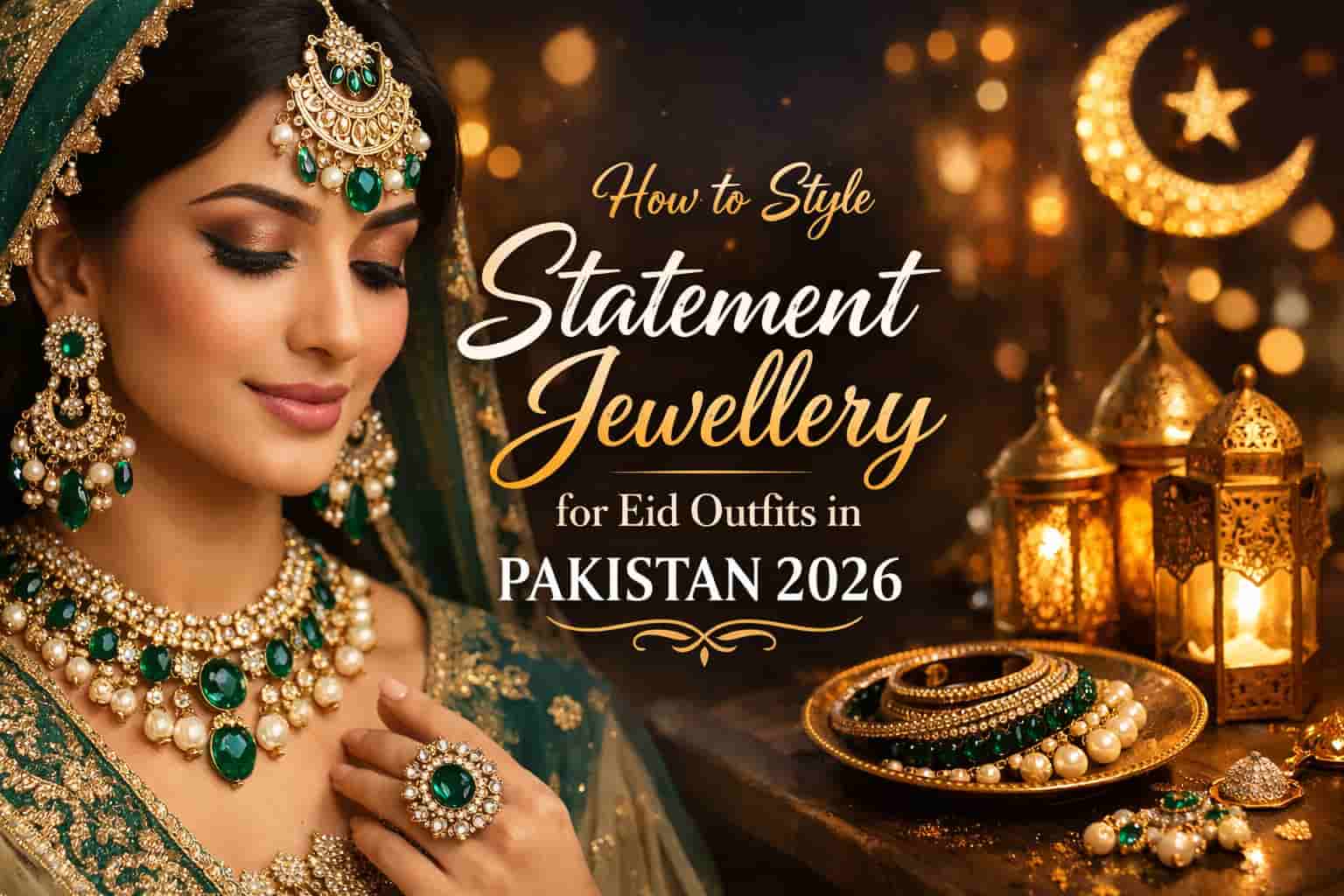
Statement jewellery for Eid outfits in Pakistan in 2026 follows 4 core styling principles: outfit weight matching, colour-tone alignment, focal point selection, and fabric-to-metal compatibility. Women across Lahore, Karachi, and Islamabad wear 3 primary outfit types on Eid, the shalwar kameez, the lehenga choli, and the saree, and each requires a different jewellery approach.
According to retail data from Pakistani jewellery markets, gold-plated 925 sterling silver pieces account for over 60% of Eid jewellery purchases in 2025-2026, driven by affordability and design variety. Understanding how to pair these pieces correctly determines whether an outfit reads as cohesive or overcrowded.
Key Takeaways
- Activate one jewellery zone at full intensity, throat, ears, or wrists, and keep the remaining 2 zones minimal. Activating all 3 simultaneously at full weight reduces the visual impact of each individual piece.
- Match jewellery weight to fabric weight. Heavy fabrics like velvet, raw silk, and embroidered katan carry gold-plated statement pieces. Lightweight fabrics like chiffon and georgette require jewellery pieces under 40 grams to avoid distorting the drape.
- Gold-toned metal pairs with warm Eid colours, deep red, emerald green, rust, and ivory. Silver-toned or rhodium-plated metal pairs with cool-palette fabrics, powder blue, lilac, mint, and dusty rose.
- Earring drop length matters when wearing a dupatta. Earrings shorter than 2.5 cm in drop length become invisible under head-covering fabric and contribute no visual value to the outfit.
- Eid spans 3 days with 3 distinct occasion types. Day 1 formal gatherings accept a full coordinated set. Day 2 friend visits suit a single focal piece. Day 3 evening events work best with cocktail rings and pendant-style pieces.
- 925 sterling silver with gold plating delivers the visual richness of solid gold at 30 to 50% of the mass, making it the practical choice for 8 to 12 hour Eid wear across prayers, family visits, and social events.
- Necklace length determines outfit coherence. A choker at 35 to 40 cm suits high and mid-level necklines. A 55 to 60 cm matinee-length piece suits deeper V-necks on formal kameez and saree blouses.
- For current Eid-specific jewellery options across all price points, the Best Eid ul-Fitr Jewellery Gifts in Pakistan 2026 guide covers pieces from PKR 10,000 to PKR 75,000 available for delivery across Pakistan.
What Is Statement Jewellery and Why It Works for Eid
Statement jewellery is any single piece or coordinated set designed to serve as the visual centrepiece of an outfit. On Eid, this includes 5 dominant categories: choker necklaces with gemstone drops, chandelier earrings, layered bridal sets, wide cuff bangles, and bold cocktail rings.
Eid ul-Fitr and Eid ul-Adha both carry strong cultural expectations around formal dressing in Pakistan. Families attend morning prayers, exchange visits, and appear in photos, occasions where jewellery visibility matters across distances of 2 to 15 metres. Statement pieces perform visually at those distances in ways that delicate jewellery does not.
Matching Statement Jewellery to 3 Core Eid Outfit Types
1. Shalwar Kameez
A shalwar kameez with heavy gota or zardozi embroidery at the neckline pairs with earring-led jewellery, not necklace-led sets. The embroidered neckline already carries dense visual weight. Adding a choker or rani haar over it creates visual conflict at the throat.
The correct approach:
- Choose chandelier earrings or jhumkas in gold-plated 925 silver as the focal point
- Add 2 to 4 matching bangles or a single bracelet on one wrist
- Skip the necklace entirely when the kameez collar has heavy embellishment above 3 cm in depth
A plain or minimal-embroidery shalwar kameez in fabrics like chiffon or organza accepts a full necklace set. For these outfits, a gold-plated necklace set with gemstone drops worn with small stud or hoop earrings maintains one focal zone.
2. Lehenga Choli
A lehenga choli accepts the heaviest jewellery load of all 3 outfit types, with sets of up to 5 coordinated pieces. The structured silhouette, open neckline of the choli, and full skirt create natural display zones across the throat, ears, wrists, and hands.
Recommended layering sequence for lehenga styling:
- Choker or multi-layered necklace set, worn directly against the collarbone
- Chandelier or drop earrings, minimum 4 cm in drop length to stay visible below the dupatta
- Stacked bangles, 6 to 12 pieces on the dominant wrist, plain on the other
- A statement ring, single cocktail style on the index or middle finger
- A maang tikka or passa, worn on the left side for standard Pakistani styling convention
The Traditional Gold Plated Necklace Set with Ruby Stones & Pearls works directly with deep red, maroon, and ivory lehenga fabrics common in Eid collections.
3. Saree
A saree styled for Eid in Pakistan pairs with a single dominant jewellery zone, either the ears or the neck, not both simultaneously. The draped fabric already creates movement and layering. Adding both a heavy necklace and large earrings produces visual clutter against the blouse’s neckline.
For saree styling specifically:
- Silk and banarasi sarees accept one statement necklace with small studs
- Chiffon sarees accept chandelier earrings with a pendant necklace rather than a full set
- Wrist jewellery on a saree stays limited to 1 bracelet or a single bangle set of no more than 4 pieces
Colour-Tone Alignment: Gold vs Silver for Eid Outfits
Gold-toned jewellery pairs with warm-hued fabrics, rust, deep red, emerald green, burnt orange, and ivory. Silver-toned or white-metal jewellery pairs with cool-hued fabrics, powder blue, lilac, mint, dusty rose, and charcoal.
Pakistani Eid fashion in 2026 shows a strong movement toward pastel shalwar kameez sets in fabrics like lawn and cotton silk. These outfits align with oxidised silver or white-rhodium-plated 925 silver pieces rather than traditional 22K yellow gold aesthetics.
The Sculptural Silver Jewellery Trends 2026 piece on Zuha Jewellery’s blog documents 6 design directions currently shaping this space, including organic forms and abstract geometric pieces that match contemporary Eid styling preferences.
Gold-plated pieces with ruby or emerald stone settings work with the 3 most popular Eid fabric colours in Pakistan: deep green (preferred in Punjab and KPK), bright red (preferred in Sindh), and off-white or ivory (preferred across all 4 provinces for Chand Raat outfits).
The One-Statement-Zone Rule
The foundational rule in Pakistani statement jewellery styling is to activate one primary zone, throat, ears, or wrists, and keep the remaining 2 zones minimal.
This rule applies to all 3 Eid outfit types and prevents the over-jewelled look that reduces the impact of individual pieces. Activating all 3 zones simultaneously at full intensity is a common styling error visible across social media Eid outfit posts in Pakistan.
Zone activation examples:
- Throat activated: Full necklace set + small stud earrings + plain bangles
- Ears activated: Chandelier jhumkas + no necklace or simple chain + 2 to 4 bangles
- Wrists activated: Stacked bangle set (8 to 12 pieces) + minimal earrings + no necklace
For bridal sets adapted for Eid wear, activate the throat and ears simultaneously only when the outfit fabric is plain or minimally embroidered. This exception applies to full bridal-style lehenga outfits worn on the first day of Eid.
Fabric Weight and Metal Compatibility
Heavy fabrics, velvet, raw silk, and heavily embroidered katan, carry gold-plated metal better than white metal, because the visual density of the fabric matches the richness of warm-toned gold.
Lightweight fabrics, chiffon, georgette, and tissue, carry both silver and gold-plated metals, but the jewellery weight itself must stay under 40 grams per piece to avoid pulling the fabric or distorting the drape.
925 sterling silver with gold plating, the base material used by Zuha Jewellery across its collections, provides the visual weight of gold at approximately 30 to 50% of the mass of solid gold pieces at equivalent sizes. This makes it the practical choice for full-day Eid wear that involves prayer, family visits, and extended social events across 8 to 12 hours.
Jewellery Styling by Eid Day and Occasion
Eid in Pakistan spans 3 days, with distinct social contexts for each:
- Day 1 (Eid prayer + family gathering): Full statement set is appropriate, necklace, matching earrings, and bangles in a coordinated design
- Day 2 (Friend visits + daytime events): Single focal piece, one statement necklace or one pair of chandelier earrings with minimal complementary pieces
- Day 3 (Evening gatherings or dawat): Cocktail rings and pendant sets work well as they balance formality with the informal nature of third-day Eid socialising
For Eid gifts, the Best Eid ul-Fitr Jewellery Gifts in Pakistan 2026 guide covers 22-karat gold sets, sterling silver bangles, and oxidised pieces across multiple price points from PKR 10,000 to PKR 75,000.
Common Styling Mistakes to Avoid
Statement jewellery for Eid outfits produces the wrong result when these 4 errors occur:
- Wearing a choker necklace over a high-neck or mandarin-collar kameez, the necklace disappears against the collar and loses its focal function
- Pairing yellow-gold jewellery with silver-tone or icy fabric embroidery, the temperature mismatch creates visual dissonance
- Stacking mismatched metals (gold and silver) across 3 or more pieces simultaneously, this works in editorial fashion but reads as unstyled in formal Eid contexts
- Selecting earring drop length shorter than 2.5 cm when wearing a dupatta over the head, shorter earrings are hidden by fabric and provide no visual contribution
Where to Buy Statement Jewellery for Eid in Pakistan 2026
Zuha Jewellery stocks 925 sterling silver gold-plated statement pieces across 9 categories, rings, necklaces, earrings, bangles, bracelets, pendant sets, bridal sets, pendants, and silver bars, with Eid-relevant designs available for delivery across Pakistan.
Orders above PKR 50,000 qualify for free shipping, and the current sale section carries pieces discounted between 2% and 17%.
The brand operates from Karachi’s Saddar Bazar and serves customers in Lahore, Islamabad, Karachi, Multan, Rawalpindi, and Quetta.
For a full overview of what is trending this season, the Top Jewellery Trends 2026 in Pakistan: Chunky Gold, Bold Pieces & Statement Styles covers 5 dominant design directions shaping Pakistani jewellery choices from Eid through the wedding season.
Frequently Asked Questions
Q: Which type of statement jewellery works best for a heavily embroidered Eid shalwar kameez?
A: Earring-led jewellery works best for heavily embroidered shalwar kameez outfits. When the neckline carries dense gota, zardozi, or dabka work above 3 cm in depth, a necklace competes directly with the embroidery and reduces the visual impact of both pieces.
Q: Can gold-plated jewellery be worn for a full 8 to 12 hour Eid day without damage?
A: Gold-plated 925 sterling silver jewellery worn for 8 to 12 hours on Eid retains its finish provided it avoids direct contact with perfume, sweat-heavy fabric, and water.
Q: Is it acceptable to mix gold-toned and silver-toned jewellery in one Eid outfit?
A: Mixing gold-toned and silver-toned jewellery in a single Eid outfit produces a cohesive result only when 1 metal dominates and the second appears as a deliberate accent across no more than 1 piece.
Q: What statement jewellery pieces are appropriate for teenage girls on Eid in Pakistan?
A: For teenage girls aged 13 to 17, lightweight statement earrings and a single delicate necklace or pendant represent the most age-appropriate and wearable Eid jewellery choice.
Q: How do you choose the right necklace length for different Eid necklines?
A: Necklace length selection for Eid outfits is determined directly by neckline depth, the deeper the neckline, the longer the necklace required to sit within the visible zone.