

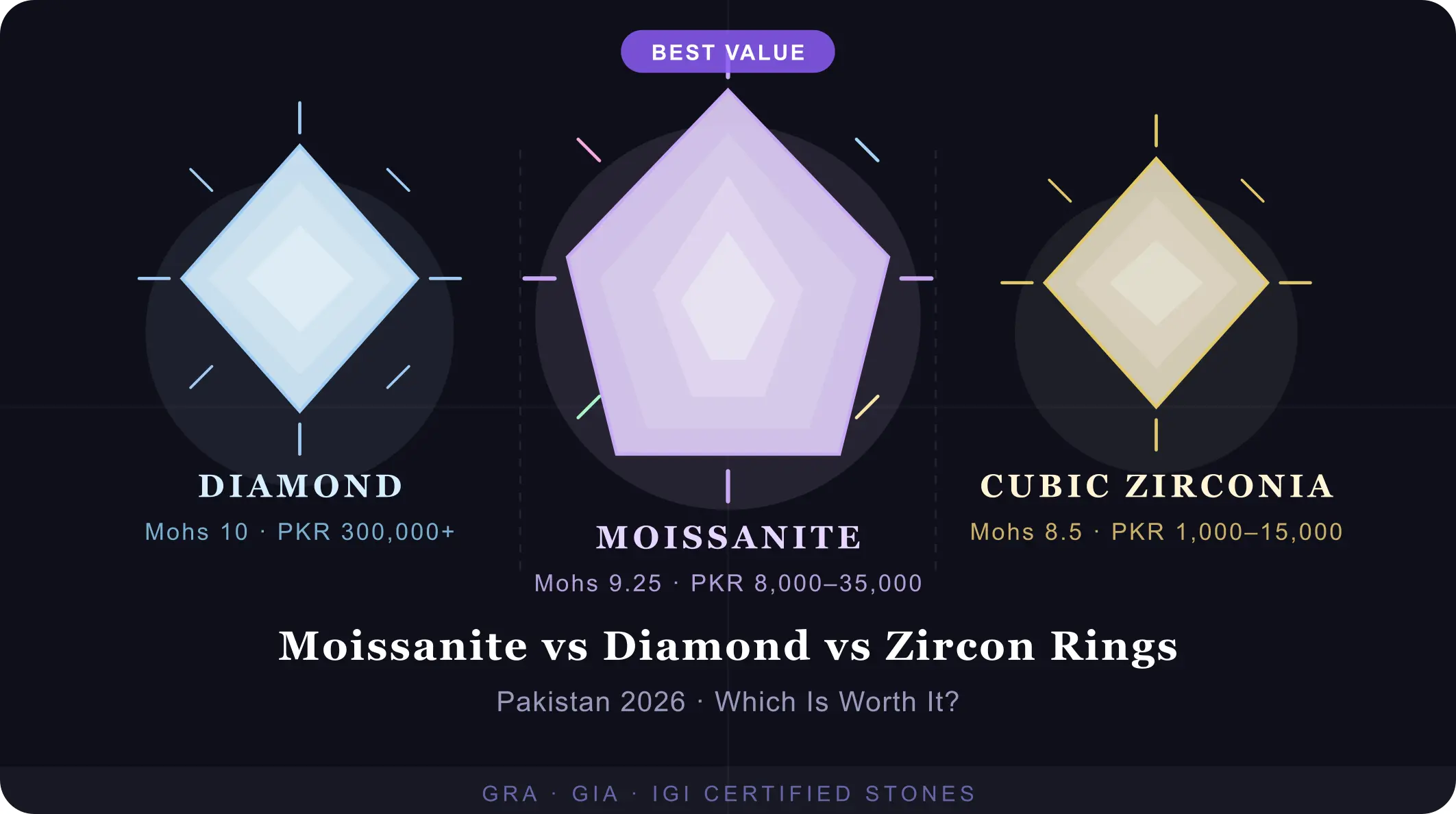
In Pakistan’s ring market in 2026, moissanite delivers the best balance of durability, brilliance, and price. Diamond offers unmatched hardness and resale value. Cubic zirconia (CZ), often called “zircon” locally, is the cheapest entry point but degrades within 2–3 years of daily wear. Each stone fits a different budget, occasion, and long-term intent.
This guide breaks down all three by hardness, optical performance, price in Pakistani Rupees, and where to buy certified stones locally and online. If you’re already browsing options, Zuha Jewellery’s rings collection carries 48+ designs in 925 sterling silver across all three stone types.
What Are These 3 Stones and Why Does It Matter in Pakistan?
Understanding what you’re buying is the first step before comparing price tags in PKR.
- Diamond is a naturally occurring carbon crystal, rated 10/10 on the Mohs hardness scale. Natural diamonds in Pakistan are imported and priced in USD-linked rates. As of 2025–2026, the diamond rate in Pakistan sits at approximately PKR 202,000 per carat for a standard commercial-grade stone, with 1-carat diamond rings ranging from PKR 300,000 to PKR 1,000,000 depending on cut, color, and clarity grade.
- Moissanite is a silicon carbide gemstone, first discovered in a meteorite crater in Arizona in 1893. Virtually all moissanite sold today is lab-created. In Pakistan, a 1-carat GRA-certified moissanite stone starts at PKR 6,000, and a complete ring in 925 sterling silver runs between PKR 8,000 and PKR 35,000. Zuha Jewellery’s La Dona Moissanite Band Ring is one such option, priced at PKR 12,000 in 925 silver.
- Cubic zirconia (CZ), commonly called “zircon” in Pakistani jewelry markets, is a synthetic zirconium dioxide crystal. CZ rings in Pakistan start as low as PKR 1,000 and rarely exceed PKR 15,000 for a sterling silver setting. For a comparison of how CZ fits into the broader jewelry spectrum, see Difference Between Artificial, Gold Plated, and Real Gold Jewellery in Pakistan.
The term “zircon” in Pakistani bazaars almost always refers to cubic zirconia, not natural zircon mineral, which is a separate gemstone (zirconium silicate, Mohs 7.5–8). When buying from local markets in Anarkali (Lahore), Zainab Market (Karachi), or F-10 Markaz (Islamabad), clarify which type you’re purchasing.
Side-by-Side Comparison: Moissanite vs Diamond vs Zircon
The 4 properties that separate these stones are hardness, refractive index, dispersion, and long-term durability.
| Property | Diamond | Moissanite | Cubic Zirconia |
| Mohs Hardness | 10 | 9.25 | 8–8.5 |
| Refractive Index | 2.42 | 2.65–2.69 | 2.15 |
| Light Dispersion | 0.044 | 0.104 | 0.060 |
| Composition | Carbon (C) | Silicon Carbide (SiC) | Zirconium Dioxide (ZrO₂) |
| Origin | Mined / Lab-grown | Lab-created | Lab-created |
| Long-term Clarity | Permanent | Permanent | Clouds within 2–3 years |
| Price (1 carat, Pakistan) | PKR 200,000+ | PKR 6,000–15,000 | PKR 500–3,000 |
Hardness and Durability: Which Stone Lasts Daily Wear in Pakistan?
Diamond is the hardest substance known, rated 10/10 on the Mohs scale, making it fully scratch-resistant for lifetime daily wear. Moissanite at 9.25 is the second-hardest gemstone used in jewelry. Cubic zirconia at 8–8.5 scratches and clouds progressively with exposure to dust, cosmetics, and cleaning products, all common in Pakistani daily life.
A Knoop indentation test comparing moissanite and CZ puts moissanite at 3,000 vs. CZ at 1,370, moissanite is 219% harder by that measure. Moissanite is also over 300% more resistant to chipping, with PSI resistance of 7.6 vs. CZ’s 2.4.
For engagement rings worn every day, especially in Pakistan’s humid summers in Karachi or dusty conditions in Lahore, diamond and moissanite both hold their surface finish indefinitely. CZ does not. If you’re buying a ring specifically for an engagement or nikah, read Engagement Rings in Pakistan: Designs, Prices & Buying Guide for a full breakdown of stone and metal options.
Brilliance and Fire: How Do They Look Under Pakistani Light Conditions?
Moissanite produces more visible sparkle than diamond in most lighting conditions, including the indoor tube lighting common in Pakistani homes and wedding venues.
Here’s what the optical data shows:
- Moissanite has a refractive index of 2.65–2.69, producing 2.36 times more rainbow-colored fire than diamond (dispersion: 0.104 vs. 0.044). Under direct light, dholki functions, mehndi nights, marquee lighting, moissanite’s rainbow flash is noticeably more intense.
- Diamond produces a cleaner, whiter sparkle. Its single-refractive nature means light exits the stone as pure white light, not a rainbow spectrum. Gemologists identify moissanite vs. diamond under a jeweler’s loupe by looking for this double refraction.
- Cubic zirconia sparkles when new but has a dispersion of 0.060 and a refractive index of 2.15 — lower than both competitors. The initial sparkle fades as oils, soap, and micro-scratches accumulate on the surface.
For Pakistani wedding occasions — nikah ceremonies, shadi functions, walima events, moissanite’s visible fire performs better than CZ and comparably to diamond, especially in event lighting. Brides looking for a complete bridal look can pair a moissanite ring with Zuha Jewellery’s Bridal Sets in matching 925 sterling silver and gold-plated designs.
Price in Pakistan: What You Actually Pay in 2026
Diamond rings in Pakistan range from PKR 80,000 for entry-level designs to over PKR 1,500,000 for 1-carat+ certified solitaires.
The price breakdown by stone type:
Diamond rings (Pakistan, 2026):
- 0.5-carat in 18k gold: PKR 50,000–90,000
- 1-carat certified (GIA/IGI) solitaire: PKR 300,000–1,000,000
- Luxury halo designs above 1 carat: PKR 500,000+
For context on how rising gold prices affect overall jewelry costs, Gold Jewellery Prices in Pakistan March 2026 covers the current rate of PKR 563,862 per tola for 24K gold and its impact on buying decisions.
Moissanite rings (Pakistan, 2026):
- 1-carat D-color VVS1 stone (loose): PKR 6,000–15,000
- Complete ring in 925 sterling silver: PKR 8,000–35,000
- Custom designs in gold-plated silver: PKR 12,000–50,000
A practical example at the affordable end: the 925 Sterling Silver Eternity Ring from Zuha Jewellery is priced at PKR 11,499, a real-world data point for what a stone-set silver ring costs in Pakistan right now.
Cubic zirconia rings (Pakistan, 2026):
- Fashion rings in gold-plated brass: PKR 1,000–5,000
- Sterling silver CZ rings: PKR 3,000–15,000
- Bridal-style multi-stone CZ sets: PKR 5,000–25,000
A moissanite ring costs approximately 85–90% less than a comparable diamond of the same carat weight. Industry data confirms moissanite is up to 90% cheaper than natural diamonds at equivalent visual size and quality.
Certification: What to Verify Before Buying in Pakistan
GRA (Gemological Research Association) certification is the standard used for moissanite sold in Pakistan; GIA and IGI are accepted for diamonds.
Before purchasing any ring in Pakistan, verify the following:
- Moissanite: Look for a GRA certificate. Sellers like Ringshing, Roxari, Zanvari, and Zuha Jewellery issue GRA-certified stones with verifiable certificate numbers. Zanvari claims to be the first brand to introduce moissanite in Pakistan and uses D-VVS1 grade stones.
- Diamond: Insist on GIA, IGI, or HRD certification. Brands offering more transparent certification include Kef Diamonds, Hanif Jewelers, Tesoro, and Damas. Entry-level diamond rings from local Lahore markets (Anarkali, Liberty Market) often lack grading reports.
- Cubic zirconia: No gemological certification exists for CZ — it is a mass-produced synthetic. Any seller claiming a “certified zircon” for PKR 2,000 is selling costume jewelry, not a certified gemstone.
Beware of counterfeit moissanite many low-quality stones are sold in Pakistan without verifiable certificates. Always ask sellers to let you verify the certificate code on the GRA website before payment. For a broader checklist of what to verify before placing any jewelry order online, read 8 Things to Check Before Ordering Jewellery Online in Pakistan.
Resale Value: Which Stone Holds Value in Pakistan?
Diamond holds the highest resale value of the 3 stones; moissanite has minimal resale market; cubic zirconia has no established resale value.
- A certified natural diamond retains 40–60% of its retail value at resale in Pakistani jewelry markets.
- Lab-grown diamonds resell at 20–40% of retail.
- Moissanite resells at a fraction of its purchase price since the market for pre-owned moissanite in Pakistan is not developed.
- CZ has no meaningful resale value in any market.
For buyers purchasing rings as long-term assets or part of a bride’s dowry (jahez), diamond is the only option with recognized monetary retention. For buyers focused on appearance, daily wear, and budget, moissanite is the stronger investment.
Which Ring Is Worth It in Pakistan in 2026?
The right choice depends on 3 factors: budget, use case, and how long the ring needs to perform.
- Buy a diamond ring if you have a budget above PKR 300,000, want a GIA/IGI-certified stone for jahez or heirloom purposes, and need confirmed resale liquidity.
- Buy a moissanite ring if your budget is PKR 8,000–50,000, you want daily wear durability (Mohs 9.25), permanent brilliance without clouding, and an ethical lab-created stone with GRA certification. Browse Zuha Jewellery’s rings collection for 925 sterling silver moissanite options with COD available across Pakistan.
- Buy a cubic zirconia ring if you need a fashion ring for occasional use, weddings, events, parties — and plan to replace it within 2–3 years. Zuha Jewellery also carries CZ designs like the Square Zircon CZ Gold Plated Bangles Set for bridal event wear.
Moissanite is the most practical choice for the majority of Pakistani buyers in 2026. It delivers diamond-comparable hardness, significantly more fire than CZ, permanent clarity, and a price point accessible to middle-income households.
For buyers in cities like Lahore, Karachi, and Islamabad who shop online, Zuha Jewellery offers 925 sterling silver rings with cash-on-delivery and free shipping on orders above PKR 50,000.
CZ, despite its low cost, is a poor choice for engagement or nikah rings. It clouds, scratches, and depreciates visually within 24–36 months of regular use. Moissanite, in contrast, maintains its refractive index and surface quality indefinitely.
Quick Reference: Which Buyer Should Choose What
| Buyer Profile | Best Stone | Reason |
| Budget under PKR 15,000 | Cubic Zirconia | Only realistic option at that price |
| Budget PKR 15,000–60,000 | Moissanite | Maximum durability and brilliance per rupee |
| Budget PKR 100,000+ | Lab-grown diamond or certified natural diamond | Resale value + GIA/IGI certification |
| Daily wear engagement ring | Moissanite | Mohs 9.25, no clouding, permanent fire |
| Jahez / dowry investment | Diamond | Recognized monetary value, resaleable |
| Occasional / event use | Cubic Zirconia | Acceptable appearance at minimal cost |