

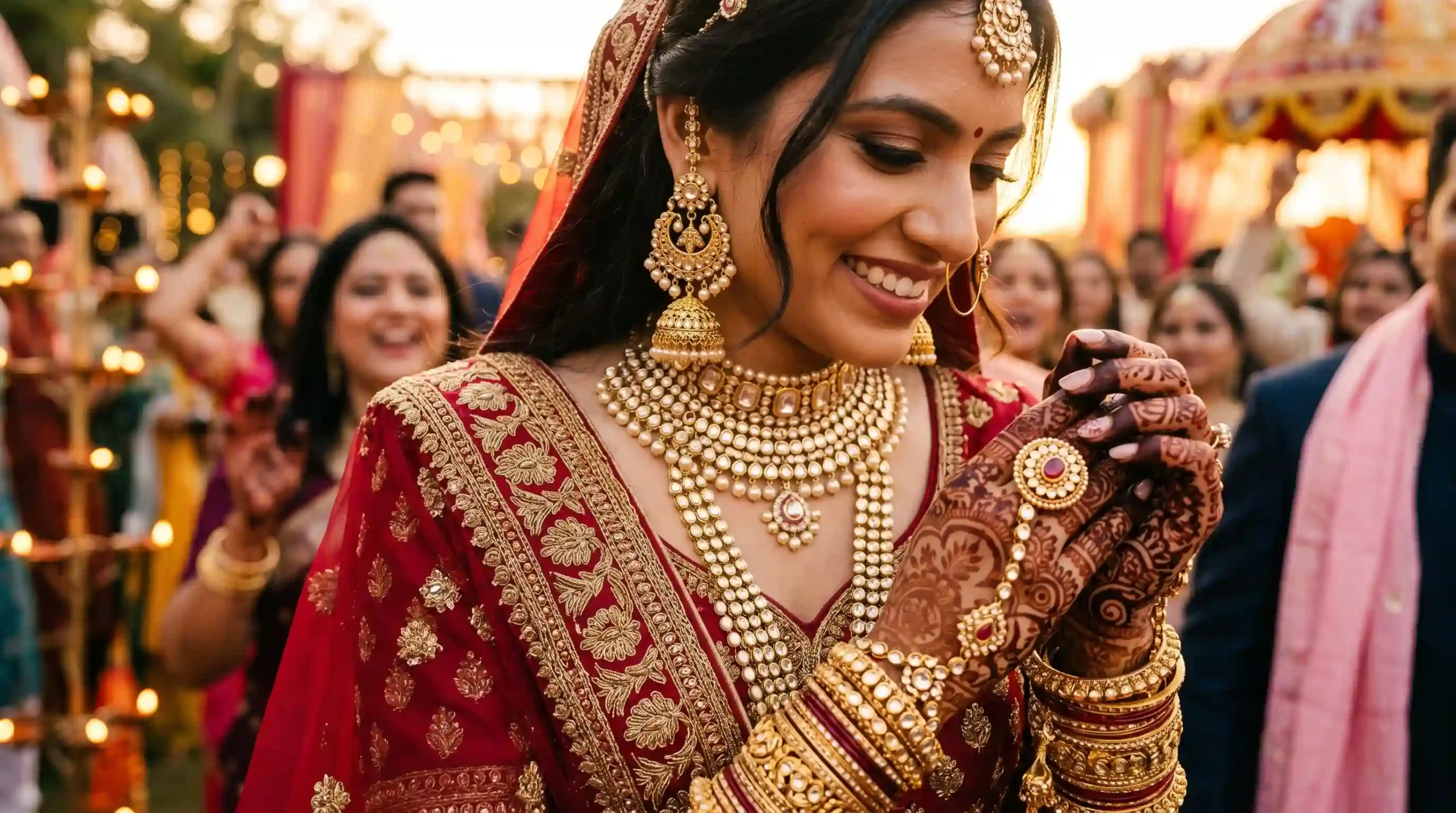
The Baraat is the most-photographed, most-watched event in a South Asian wedding. Every relative with a phone is filming. Every guest is looking. And unlike the Mehndi or Walima, you do not get a quieter moment to fix a missing tikka or swap out earrings that are pulling too hard.
Jewellery for a Baraat is not the same as jewellery for any other function. The event involves dancing, long standing periods, outdoor lighting, marquee lighting, and, if you are on the bride’s side, the emotional weight of a farewell. Every piece you choose needs to work across all of that.
This guide covers the bride’s full jewellery look for the Baraat, and then breaks down exactly what the bride’s mother, sisters, and female family members should wear so the whole family photographs beautifully without anyone accidentally upstaging the person the day is actually about.
The Bride’s Baraat Jewellery: The 7 Essential Pieces
A Baraat bridal set has 7 core pieces: the necklace, earrings, maang tikka, jhoomar or passa, nath, bangles or chura, and the haath phool or hand harness. Each one has a specific role in the overall look, and the decisions you make about one piece directly affect what works for the others.
The Necklace: Lead With Weight, Not Just Design
The bridal necklace is the centrepiece of the entire set, and the most important factor is not style, it is weight distribution. A heavy kundan or polki choker worn for 10 to 12 hours causes genuine neck and shoulder strain. The most practical and visually effective Baraat necklaces are layered sets, a choker paired with a longer haar, because they distribute weight across a wider area and photograph with more depth than a single statement piece.
Kundan remains the most popular choice for Baraat bridal necklaces in Pakistani and North Indian weddings because its uncut gemstones set in gold foil catch both natural and marquee light equally well. Polki, which uses raw uncut diamonds, delivers a more antique and regal look, but requires more careful handling during the procession. For brides choosing red or maroon bridal wear, a gold-toned kundan set with ruby or emerald accents is the most cohesive choice. For brides in lighter shades like ivory, champagne, or pale pink, a pearl-accented kundan or a white polki set reads more proportionate.
Avoid single-strand pearl or gold chain necklaces for the Baraat. They photograph as underwhelming against heavily embroidered bridal lehengas or shararas, and the event calls for the full formal weight of a bridal set.
Earrings: Match the Scale of Your Necklace
Baraat earrings follow one rule: the scale of the earring must match the scale of the necklace. A heavy layered kundan necklace with small stud earrings creates visual imbalance that is immediately obvious in photographs. A full bridal necklace calls for chandelier earrings or jhumkas that drop to at least the jawline.
Jhumkas, the bell-shaped drop earrings with a dome top, are the most traditional and structurally appropriate Baraat earring for 3 reasons. First, their weight is balanced, with the dome sitting on the earlobe and the bell hanging freely. Second, their movement photographs beautifully during the procession.
Third, they are available across every jewellery style from plain gold to meenakari to kundan, making coordination straightforward.
Chandelier earrings work well for brides who find jhumkas too traditional, but check the length. Earrings that reach the collarbone or below can catch on a dupatta during the procession, and losing an earring mid-Baraat is far more common than most brides expect.
Maang Tikka: Placement Determines Everything
The maang tikka is a pendant on a chain that sits at the centre parting of the hair and rests on the forehead. For the Baraat, the 3 most effective maang tikka styles are the classic single-drop pendant, the layered passa-style tikka, and the jhoomar.
The jhoomar is specifically a side-swept headpiece worn on the right side of the head, descending from a hair attachment to rest near the temple. It is most common in Pakistani Punjabi bridal traditions and, when worn correctly, it is the single most dramatic piece in the entire bridal jewellery look.
Many brides wear both a central maang tikka and a jhoomar together, the tikka at the centre parting and the jhoomar sweeping to the right side.
The passa is a similar side ornament but more minimalist, sitting flat against the hair rather than dangling. For brides with smaller faces or lighter bridal outfits, the passa is a proportionate alternative to the full jhoomar.
For Baraat specifically, secure the maang tikka chain with a small bobby pin at the hairline. The procession involves movement, and a loose tikka that slides out of place by the time you reach the venue is one of the most common jewellery mishaps at Baraats.
The Nath: Size Is a Personal Decision, Not a Tradition
The nath is a bridal nose ring, and it carries cultural significance across Pakistani, North Indian, and many regional South Asian traditions. For the Baraat, nath size is purely a personal and practical decision.
Large naths that connect to the ear via a chain are visually dramatic and deeply traditional, but they limit head movement and can cause discomfort over a long event. Smaller, self-supporting naths offer the same cultural presence with more comfort.
If this is your first time wearing a nath, get the piercing done at least 6 weeks before the wedding, not days before, to allow proper healing. A fresh or semi-healed piercing under the weight of a bridal nath during a Baraat is unnecessarily uncomfortable.
For brides who do not have a nose piercing, clip-on naths are widely available and photograph identically to pierced versions. The wire clip holds reliably through the Baraat procession, though it is worth testing with your full look at a trial run.
Bangles and Chura: The One Piece With a Non-Negotiable Rule
Punjabi brides wear a chura, a set of 21 red and ivory bangles, as a central piece of the Baraat look. The chura is traditionally worn for 40 days after the wedding. It is applied by the bride’s maternal uncle (mama) at the Mehndi, and it is not removed before the Baraat.
For brides not wearing a chura, Baraat bangles fall into 2 categories: heavy gold or kundan kangan (rigid bangles worn as a set of 2 or 3 on each wrist), or a mixed stack of gold, glass, and gemstone bangles that match the colour of the bridal outfit.
The mixed stack works better for brides with heavily embellished necklaces because it draws the eye downward to complete the full look without competing with the neckline.
Haath Phool: Optional but Photographically Powerful
The haath phool is a hand harness that connects a ring to a bracelet via a chain across the back of the hand.
It is not a standard piece in every regional tradition, but it photographs exceptionally well in close-up bridal shots and adds significant visual detail to the hand mehendi reveal shots that are now a standard part of every Baraat photography package.
For brides who want the full effect without the structural complexity, a simple kundan or polki ring paired with a matching bracelet achieves a similar visual result.
The Bride’s Mother: Elevated, Not Bridal
The mother of the bride has a specific jewellery challenge at the Baraat. She is standing at the centre of the rukhsati, the farewell, which means she is in almost every photograph.
Her jewellery needs to read as formal and celebratory without accidentally looking bridal.
The 3 jewellery rules for the bride’s mother at the Baraat are: match the metal tone of your outfit, keep the scale one step below the bride’s, and prioritise comfort over drama.
For a mother wearing a silk or brocade saree in gold or champagne tones, a gold jhumka set with a single-strand pearl or gold necklace is the most appropriate choice.
For a mother wearing a heavily embroidered kurta set in jewel tones like deep green, burgundy, or royal blue, a kundan or meenakari set with matching colour accents ties the look together visually.
A common mistake mothers make at the Baraat is wearing their heaviest or most elaborate jewellery because the occasion feels like it calls for it. It does not.
The bride is wearing a full 7-piece set. A mother in a matching layered necklace and jhoomar combination reads as competing, not celebrating. A beautiful single statement necklace with coordinating earrings, a set of gold bangles, and a modest tikka is the right level.
The Bride’s Sisters and Female Cousins: Festive Without Stealing Focus
The bride’s sisters and female cousins are the most visible non-bride women at the Baraat, and their jewellery decisions have a direct effect on how the family photographs as a group.
The fundamental rule is: complement the bride’s colour family, do not echo her jewellery set. If the bride is wearing a full kundan set in gold and green, her sisters should not wear matching kundan.
They should wear jewellery in a complementary style, gold jhumkas, a simple polki or gemstone necklace, or a meenakari set that picks up one colour from their outfit without mirroring the bride’s pieces.
For sisters in lehengas or shararas in deep jewel tones, meenakari jewellery is particularly effective because its enamel colours can be matched precisely to the outfit.
A meenakari jhumka set with a matching choker in emerald green for a bottle-green lehenga, for instance, creates a polished, coordinated look that photographs well alongside the bride without competing.
For baraat outfits in lighter or neutral tones like ivory, blush, or silver, a pearl and gold combination gives festive formality without heaviness.
Sisters should avoid 2 things specifically: wearing tikkas that are more elaborate than the bride’s, and wearing naths unless the bride is also wearing one.
Both of these read as attempting to share the bride’s specific jewellery identity, which photographs awkwardly in group shots.
The Bride’s Aunts (Phuppos and Khalas): Rich Fabrics, Modest Jewellery
Female aunts at the Baraat occupy a ceremonial role, they are often part of the rukhsati rituals, but their jewellery should sit in the background of photographs rather than the foreground.
Gold or gold-toned jewellery in classic designs is the most appropriate choice: a simple gold or kundan necklace, matching earrings, and a set of gold bangles.
Aunts who own heirloom gold jewellery, pieces passed down through families, wear it most appropriately at the Baraat, since the event is the formal culmination of the wedding celebrations and the one function where such pieces carry their full weight.
Statement pieces like jhumars, layered sets, or elaborate haath phool are not appropriate for aunts at a Baraat unless they are specifically coordinated as part of the bridal family’s unified look by the bride herself.
4 Baraat Jewellery Mistakes the Whole Family Makes
Wearing new jewellery without a trial. Earrings that pull differently than expected, tikkas that do not sit right with the hairstyle, naths that feel unfamiliar, all of these problems appear at the event if they were not tested before it. Wear the full jewellery set with the full bridal outfit, complete hairstyle, and shoes at least once before the Baraat.
Mismatching metal tones across pieces. Gold and silver mixed without intention reads as unplanned. Decide on a metal tone, gold, rose gold, or white gold, and keep every piece within that family.
The one exception is when the bridal outfit itself mixes warm and cool embroidery tones, in which case a predominantly gold set with one white polki piece can bridge both.
Overloading the neckline. A heavily embroidered neckline on a bridal lehenga already carries significant visual weight. Adding a heavy, multi-strand necklace on top creates a cluttered look that loses detail in photographs.
For embroidered necklines, a closer-fitting choker or a single necklace with open space around it works better than a layered set.
Forgetting the back. Backless or low-back bridal blouses (cholis) are a strong current trend in bridal wear. If the bridal blouse has a significant back detail, a long haath phool chain, a long nath chain, or a long tikka chain that falls on the back creates an additional visual element that photographs beautifully in the procession shots from behind.
A Quick Reference: Jewellery by Role at the Baraat
Bride: Full set, layered necklace, jhumka or chandelier earrings, maang tikka, jhoomar or passa, nath, chura or bridal bangles, haath phool optional.
Bride’s mother: Single statement necklace, coordinating earrings, gold bangles, modest tikka. Keep scale one level below bridal.
Bride’s sisters: Complementary style to bride, meenakari, polki, or pearl sets in outfit-matching tones. Avoid tikkas more elaborate than the bride’s and avoid naths.
Bride’s aunts: Classic gold or heirloom jewellery. Necklace, earrings, bangles. No jhumars or elaborate stacked sets.
Bride’s cousins and friends: Festival-level jewellery. Jhumkas, a single necklace, bangles. Jewel tones in meenakari or kundan work well. Keep it below the level of family members in the formal ceremony roles.
The Baraat is the one function where every piece of jewellery you put on gets seen by everyone in the room, photographed from every angle, and remembered in every video.
Getting the choices right, not just for the bride but for the whole family, means the photographs from that day tell a cohesive, intentional story. That is worth spending the time on.