

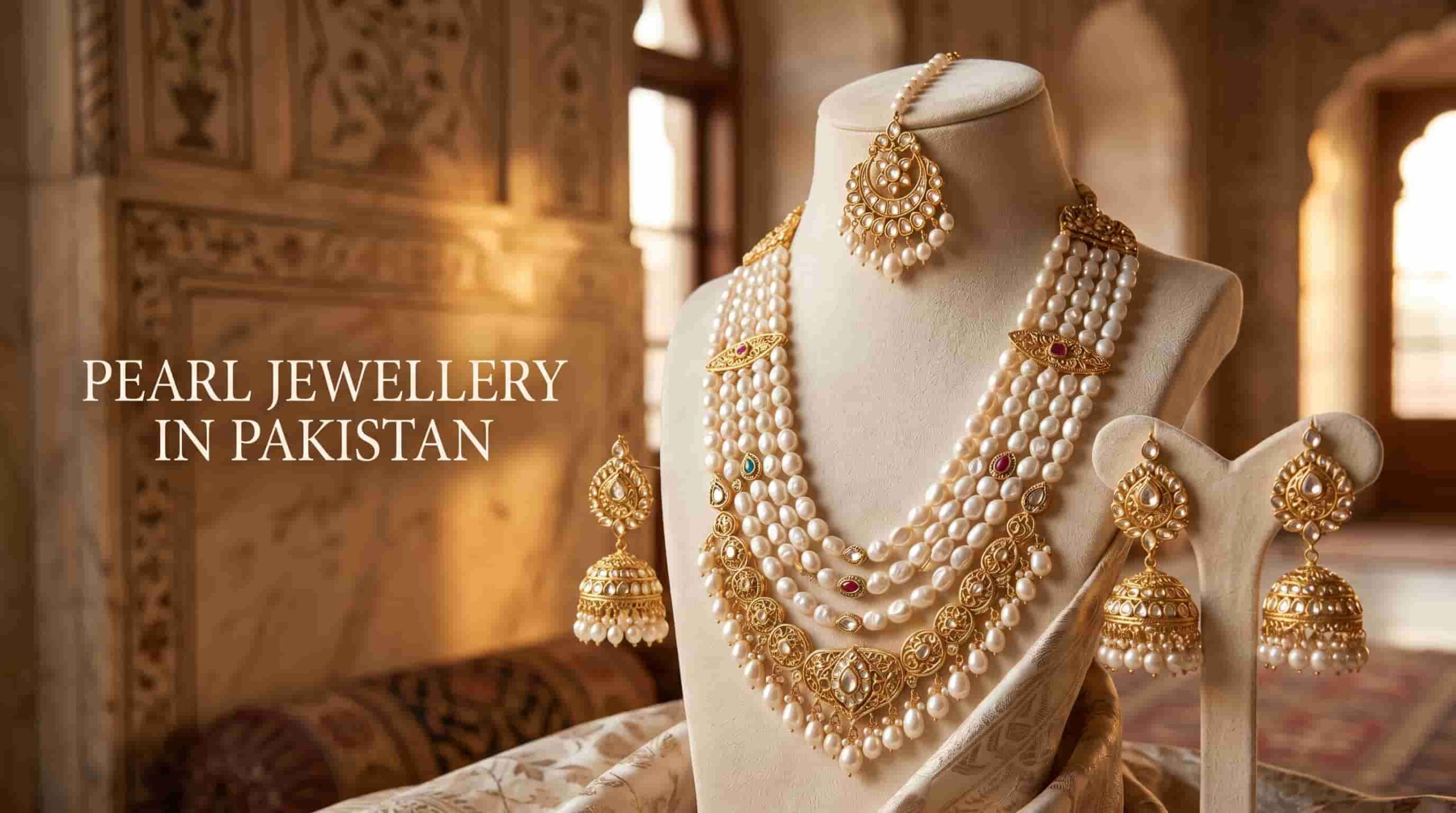
Pearl jewellery in Pakistan includes freshwater, cultured, sea water, and artificial options, with prices ranging from Rs. 300 to over Rs. 3,00,000 depending on type and quality, available online with cash on delivery across Lahore, Islamabad, Karachi, and Rawalpindi.
Why Pearl Jewellery Is Having a Moment in Pakistan
Pearl jewellery is no longer reserved for brides or formal dinners. Over the past three years, Pakistani women have started wearing pearls for Eid, casual outings, and even as everyday office accessories.
Pearls have deep roots in South Asian culture. In Mughal-era Pakistan and the broader subcontinent, pearls were symbols of royalty, purity, and status, worn by queens and gifted at weddings as a sign of prosperity. Hyderabad, historically one of the world’s most important pearl trading cities, connected South Asian buyers directly to Gulf sea water pearls for centuries. That cultural connection has never fully disappeared.
Two things are now driving a modern revival. First, the rise of minimalist styling, small pearl studs, single-strand necklaces, and thin pearl bracelets pair well with both eastern and western outfits. Second, online shopping has made pearl jewellery widely accessible at prices that start under Rs. 1,000 for artificial options.
From Bridal Sets to Everyday Minimalist Pieces
Traditionally, pearl jewellery in Pakistan was dominated by heavy bridal sets, layered necklaces, maatha patti, and jhumkas for wedding functions. That market still exists and remains strong.
What has grown alongside it is the demand for lighter, simpler pieces. A single freshwater pearl on a gold-plated chain. A pair of baroque pearl hoops. These are now regular purchases, not once-in-a-decade ones.
How Modern Pakistani Women Are Wearing Pearls Differently
Pakistani women now layer pearl necklaces with stone pendants, mix pearl earrings with gold hoops, and pair pearl bracelets with oxidised silver bangles. This styling flexibility has expanded the market well beyond the traditional bridal context.
Types of Pearl Jewellery Available in Pakistan
Pearl jewellery sold in Pakistan falls into 4 main categories: freshwater pearls, cultured (sea water and semi-cultured) pearls, artificial or imitation pearls, and pieces differentiated by metal setting, gold-plated or sterling silver.
Freshwater Pearls — The Most Affordable Real Option
Freshwater pearls are real pearls produced by mussels in lakes and rivers, primarily in China. They are the most widely available genuine pearl type in Pakistan.
Key facts about freshwater pearls:
- Size range: 4mm to 12mm in most retail pieces
- Colours available: white, cream, pink, lavender, and peach
- Shapes: round, oval, button, and baroque (irregular)
- Luster: good to very good, though lower than Akoya saltwater pearls
- Price range in Pakistan: Rs. 2,000 to Rs. 15,000 for a standard necklace set
Freshwater pearls are not fake or inferior. They are genuine organic gems, simply more accessible in price because they are produced in larger quantities than saltwater varieties.
Cultured Pearls — Semi-Cultured, Sea Water, and Tahitian
Cultured pearls are real pearls grown with human assistance. A small nucleus, either a bead or piece of tissue, is implanted into the mollusc to trigger pearl formation. The result is a genuine pearl, chemically identical to a wild natural pearl.
Three sub-types are available in Pakistan:
Semi-cultured pearls are grown in freshwater environments with a tissue nucleus. They are a step up in luster and roundness from standard freshwater pearls and typically priced between Rs. 8,000 and Rs. 30,000 for a necklace set.
Sea water pearls — including Akoya pearls, are grown in saltwater oysters and are known for their high luster and near-perfect round shape. Akoya pearl necklaces start at approximately Rs. 20,000 and go significantly higher for matched strands with strong orient.
Tahitian pearls — often called black pearls, are grown in French Polynesia and range in colour from dark grey and blue-green to deep green and violet. They are among the most visually distinctive pearl types available and are priced from Rs. 50,000 upward for a necklace strand.
Al Qasim Jewellers in Pakistan explicitly stocks freshwater, semi-cultured, and sea water pearl jewellery, making them one of the few local retailers to distinguish between these categories clearly.
Artificial / Imitation Pearls — Who They Are For and What to Expect
Artificial pearls are not real pearls. They are made from glass, plastic, or ceramic coated with a pearl-like substance to mimic the look of genuine pearls.
They are a legitimate choice for:
- Budget buyers who want the aesthetic without the cost
- Frequent party or event wear where damage risk is higher
- Costume jewellery paired with heavily embellished outfits
Price range for artificial pearl jewellery in Pakistan: Rs. 300 to Rs. 3,000 for sets.
The key limitation is durability. The coating on artificial pearls wears off over time, especially with exposure to perfume, sweat, and moisture. A genuine freshwater pearl necklace will outlast an artificial one by decades if cared for properly.
Gold-Plated vs Sterling Silver Pearl Settings
The metal setting affects both the price and the longevity of the piece.
Gold-plated settings use a base metal (usually brass or copper) coated with a thin gold layer. They are affordable, available widely in Pakistan, and look premium. However, the plating fades with regular wear and exposure to chemicals. Most Pakistani pearl jewellery in the Rs. 2,000 to Rs. 10,000 range uses gold-plated settings.
Sterling silver settings use 92.5% pure silver and are more durable than gold-plated alternatives. Sterling silver pearl pieces are available from stores like Soulfeel Pakistan and A Gold Story, usually in the Rs. 5,000 to Rs. 25,000 range.
Pearl Jewellery Price Range in Pakistan
| Pearl Type | Price Range (PKR) | Best For |
| Artificial / Imitation | Rs. 300 — Rs. 3,000 | Events, costume wear, budget buyers |
| Freshwater (basic) | Rs. 1,500 — Rs. 8,000 | Everyday wear, casual gifting |
| Freshwater (quality grade) | Rs. 8,000 — Rs. 20,000 | Bridal wear, formal events |
| Semi-cultured | Rs. 12,000 — Rs. 35,000 | Weddings, premium gifting |
| Sea water / Akoya | Rs. 20,000 — Rs. 80,000+ | Luxury purchases, heirloom pieces |
| South Sea / Tahitian | Rs. 50,000 — Rs. 3,00,000+ | Collectors, investment-grade jewellery |
Budget Options (Artificial and Basic Freshwater)
For under Rs. 3,000, most available options are artificial pearl sets. For Rs. 3,000 to Rs. 8,000, basic freshwater pearl necklace sets with gold-plated settings are available from stores like Daraz, Zeverat, and Rawayat.
These pieces are suitable for regular wear and look very similar to more expensive options from a visual distance.
Mid-Range (Cultured Freshwater Sets)
Between Rs. 8,000 and Rs. 35,000, quality freshwater and semi-cultured pearl sets become available. At this price point, pearl luster improves noticeably, nacre thickness increases, and settings move toward sterling silver or better-quality gold plating.
Brands like Dango.pk and A Gold Story operate in this range.
Premium (Real Sea Water and South Sea Pearls)
Above Rs. 35,000, the market shifts to Akoya, South Sea, and Tahitian pearls. These are investment-grade pieces with significantly stronger luster, near-perfect roundness, and thicker nacre. Natural (wild) pearls, extremely rare, can exceed Rs. 5,00,000 for a matched strand.
South Sea and Tahitian pearls are widely considered investment-grade gems. Unlike gold-plated or freshwater pieces, a well-matched South Sea strand holds its value over decades and can appreciate if the pearls are large, round, and high-luster. Proper storage, in a breathable cloth pouch, away from other jewellery and chemicals, is essential to maintaining that value long term.
Price Factors That Matter: Size, Luster, Shape, and Nacre
Four technical factors determine the value of any real pearl:
- Luster — The intensity and depth of the pearl’s reflective glow. High-luster pearls show a sharp, mirror-like reflection. Low-luster pearls look chalky or dull.
- Nacre thickness — Nacre is the organic material that forms the pearl. Thicker nacre means better luster, more durability, and higher value.
- Shape — Perfectly round pearls are the rarest and most expensive. Baroque (irregular) and button shapes are less valuable but increasingly popular in modern jewellery.
- Size — Larger pearls are rarer and priced higher. Each millimetre of additional diameter represents a significant price increase in high-quality pearls.
How to Tell Real Pearls from Fake Ones
Identifying real pearls does not require a laboratory. Four practical tests work reliably.
The Tooth Test (Quick and Reliable)
Rub the pearl gently across the edge of your upper front teeth. Real pearls, whether natural or cultured, feel slightly gritty or sandy. This texture comes from the microscopic crystalline structure of nacre. Fake pearls feel completely smooth.
This test works because nacre has a layered crystalline structure that creates surface friction. Glass, plastic, and ceramic coatings do not have this texture.
Checking Luster and Surface Imperfections
Real pearls have deep, layered luster, look for a reflection with depth, not just surface shine. When you hold a real pearl up to light, you see a glow that appears to come from inside the pearl.
Real pearls also have minor surface imperfections, small ridges, bumps, or variations in colour. Completely flawless, uniform pearls at low prices are almost always artificial.
Weight, Temperature, and Drill Hole Checks
Real pearls are noticeably cool to the touch when first picked up, warming slowly against the skin. Fake pearls tend to reach room temperature quickly.
Real pearls are also denser than most artificial versions. A genuine pearl necklace strand feels heavier than an equivalent artificial one.
When buying drilled pearls (for earrings or strung necklaces), examine the drill hole. Real pearls have clean, sharp drill holes. Artificial pearls often show flaking or chipping of the coating around the drill hole.
What to Ask a Seller Before You Buy
Before purchasing, ask these 4 questions:
- Are these freshwater, cultured, or artificial pearls?
- What is the metal setting, gold-plated base metal or sterling silver?
- Do you provide any certificate or documentation for sea water or premium pearls?
- What is the return or exchange policy if the product does not match the photos?
A reputable seller answers all four without hesitation.
Pearl Jewellery for Every Occasion in Pakistan
Bridal and Wedding Pearl Sets
Pearl jewellery is a staple of Pakistani bridal styling. Traditional sets include layered pearl mala necklaces, pearl and gold jhumkas, pearl maatha patti, and pearl haath phool.
For brides, the right set depends on the occasion. Mehndi functions suit lighter, pearl-and-floral or pearl-and-kundan combination pieces, heavy layered sets are overdressed for a daytime event. Barat is the occasion for a full layered pearl set, maatha patti, and matching earrings. Walima calls for something simpler, a single-strand pearl necklace or pearl choker with drop earrings works well without competing with the outfit.
Neckline matters too. Pearl chokers complement boat necks and square necklines. Longer mala-style strands suit round necklines and V-necks on lehengas or shirts.
In wedding photography, real pearls perform noticeably better than artificial ones. Genuine nacre reflects flash and natural light with a warm, layered glow that reads beautifully on camera. Artificial pearl coatings tend to produce a flat, over-bright reflection that looks plastic in close-up photographs.
Freshwater and cultured pearl sets in the Rs. 15,000 to Rs. 60,000 range offer the best combination of quality and value for brides.
Key bridal pearl jewellery types:
- Layered pearl necklace sets (2 to 5 layers)
- Pearl choker with matching jhumkas
- Pearl and kundan combination sets
- Pearl maatha patti and tikka sets
Formal Events and Eid Wear
For formal dinners, Eid functions, and family celebrations, single-strand pearl necklaces with matching earrings are the most versatile choice. A freshwater pearl set in the Rs. 5,000 to Rs. 15,000 range covers most formal occasions without over-dressing.
Pearl choker necklaces have become particularly popular for formal Pakistani events because they pair well with both lawn suits and semi-formal dresses.
Everyday and Minimalist Pearl Pieces
For daily wear, smaller and lighter pieces are practical. Pearl stud earrings (6mm to 8mm), single pearl pendant necklaces, and thin pearl bracelets are the most popular everyday options.
At this category, gold-plated sterling silver settings work best, they are light, durable enough for daily use, and priced between Rs. 2,000 and Rs. 8,000.
Best Styles to Shop Right Now
Pearl Necklace Sets
Pearl necklace sets, a necklace with matching earrings, are the most popular purchase category. The classic single-strand white pearl necklace remains the best seller, but layered baroque pearl necklaces and pearl-with-gold-bead combination strands are growing in demand.
Pearl Earrings (Hoops, Drops, Studs)
Pearl earrings in Pakistan are available in 3 dominant styles:
- Stud earrings — a single pearl on a post, suitable for daily wear
- Drop earrings — a pearl suspended from a hook or chain, popular for formal events
- Hoop earrings with pearl accents — a modern style where small pearls line the inside or outside of a metal hoop
Pearl Bracelets and Chokers
Freshwater pearl stretch bracelets (Rs. 1,500 to Rs. 5,000) are popular as standalone pieces and for stacking. Pearl choker necklaces, fitted closely around the neck, have become one of the most searched pearl styles in Pakistan over the past two years.
Pearl Jewellery Sets for Brides
Full bridal pearl sets (necklace, earrings, tikka, and sometimes maatha patti) are available from specialist stores. A Gold Story’s Mumtaz Real Pearl Necklace is one well-known example of a real freshwater pearl piece positioned for this segment. Noor’s Jewellery Collections offers handmade real pearl strings starting at Rs. 12,000.
Pearl is also the traditional birthstone for June, making pearl jewellery sets a popular gift choice for brides or anyone celebrating a June birthday.
How to Care for Your Pearl Jewellery
Pearl care is straightforward but important. Pearls are organic and more fragile than metal or stone jewellery.
What to Keep Pearls Away From
Avoid contact with these 5 substances:
- Perfume and hairspray — chemicals break down the nacre surface over time
- Water — prolonged exposure weakens the string of strung pearls and damages settings
- Lotions and creams — build up on the surface and dull luster
- Bleach and cleaning products — permanently damage nacre
- Sweat — acidic perspiration causes gradual surface erosion
The practical rule: put your pearls on last, after all grooming products have been applied. Take them off first.
How to Clean and Store Pearls Properly
Wipe pearls with a soft, dry cloth after each wear. For heavier cleaning, use a slightly damp cloth, then dry immediately.
Do not use ultrasonic cleaners, steam cleaners, or abrasive cloths.
Store pearls in a separate soft pouch or cloth-lined box. Storing pearls loose with other jewellery causes surface scratching.
Making Your Pearls Last Longer
Strung pearl necklaces stretch over time. Have them restrung by a jeweller every 2 to 3 years if worn regularly. A well-maintained freshwater pearl necklace can last 20 to 30 years without significant quality loss.
Where to Buy Pearl Jewellery Online in Pakistan
Trusted Stores With COD and Nationwide Delivery
Shop Pearl Jewellery at Zuha Jewellery
Explore pearl and zircon earrings plus pearl-accented pendant designs from Zuha Jewellery. View current prices and availability, with Cash on Delivery and nationwide delivery across Pakistan.
Shop Pearl Stud Earrings View Pearl & Ruby Pendant Set
Need help before ordering? WhatsApp us at +92 322 8201055.
Several online retailers deliver pearl jewellery across Pakistan with cash on delivery:
- Daraz.pk — largest selection, multiple sellers, prices from Rs. 300 upward, ships to all major cities including Karachi, Lahore, and Islamabad
- Dango.pk — curated freshwater pearl collection, free delivery above Rs. 6,000
- Zeverat.pk — pearl necklace sets with delivery to Lahore, Islamabad, Rawalpindi, and Peshawar
- Rawayat.com.pk — gold-plated pearl sets with quality guarantee
- A Gold Story — real freshwater pearl pieces with domestic and international shipping
- Noor’s Jewellery Collections — handmade real pearl strings, delivery 8 to 15 working days nationwide
What to Look For When Buying From an Online Seller
Before confirming an order, check these 5 things:
- Product photos — are they showing actual stock or stock imagery?
- Seller reviews and ratings — look for specific mentions of pearl quality
- Return policy — can you return if the item does not match the description?
- Pearl type listed — is it clearly stated as freshwater, cultured, or artificial?
- Contact availability — is a WhatsApp number or phone listed for pre-purchase questions?
Frequently Asked Questions
Are freshwater pearls real pearls?
Yes. Freshwater pearls are genuine organic gems produced by mussels in freshwater lakes and rivers. They are real pearls, not imitations. The distinction from artificial pearls is that they contain actual nacre throughout.
What is a fair price for a pearl necklace set in Pakistan? A genuine freshwater pearl necklace set in Pakistan should cost between Rs. 3,000 and Rs. 15,000 depending on pearl size, quality, and metal setting. Sets priced below Rs. 1,500 are almost certainly artificial. Sets above Rs. 20,000 are typically cultured or semi-cultured pearls with better luster and nacre thickness.
Can I wear pearl jewellery daily? Yes, with care. Freshwater pearl stud earrings and pendants are suitable for daily wear. Avoid wearing pearl jewellery while applying perfume, exercising, or washing hands. Remove pearl rings and bracelets before any water contact. With these precautions, a good freshwater pearl piece will last years of daily wear.
How do I know if a pearl is natural or cultured? Visually, it is almost impossible to tell. The tooth test identifies real vs fake (nacre vs coating), but distinguishing a natural pearl from a cultured one requires X-ray examination of the internal structure. Natural pearls have concentric nacre layers throughout. Cultured pearls have a visible nucleus at the core. For practical purposes, treat all retail pearls as cultured — wild natural pearls are extremely rare and almost never sold in retail.
Are pearls a June birthstone? Yes. Pearl is the traditional birthstone for June. This makes pearl jewellery a widely chosen gift for anyone born in June, as well as for brides who marry during summer months.