

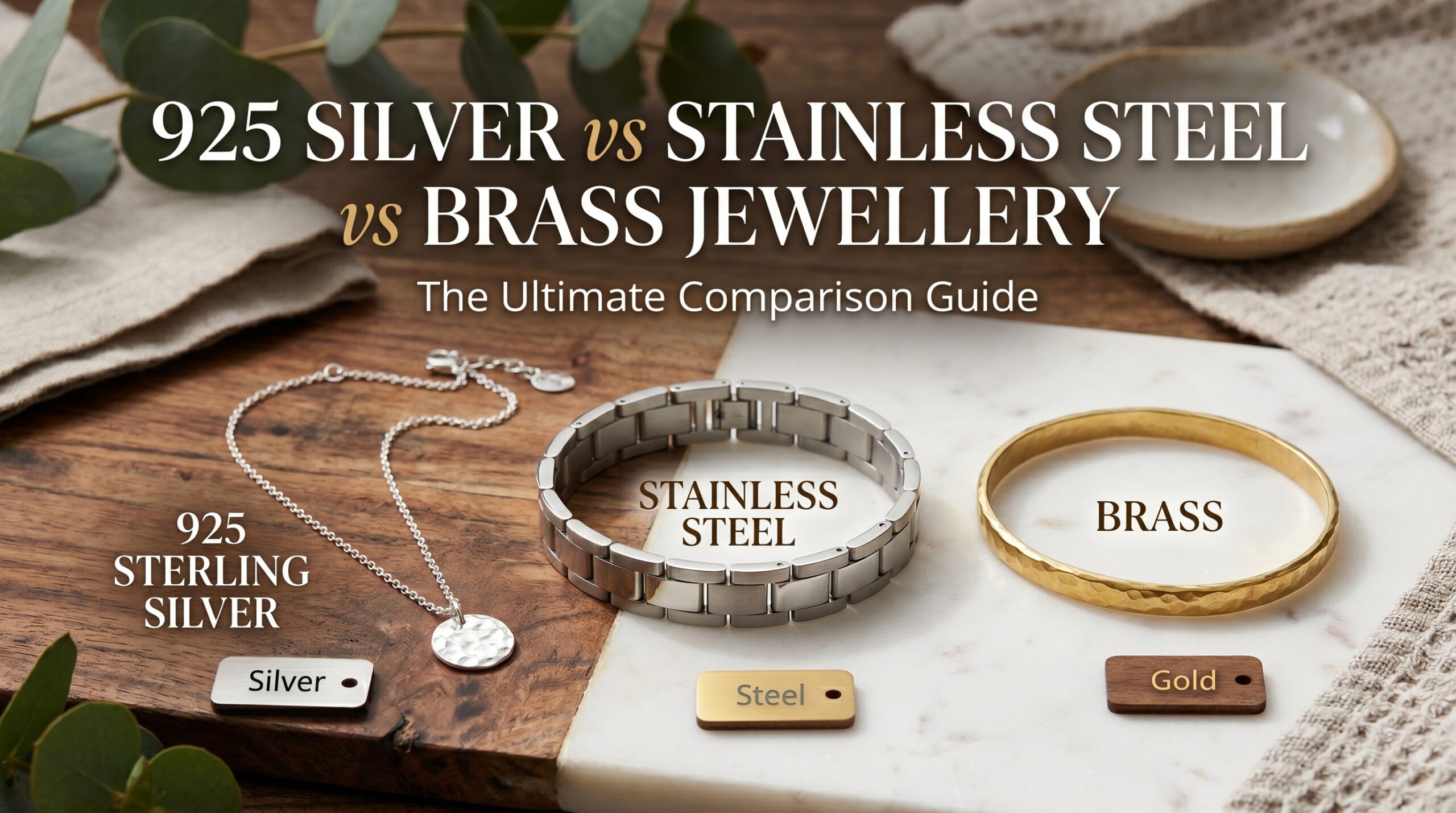
925 silver lasts longer than brass in Pakistan’s climate, but stainless steel outperforms both in resistance to humidity, sweat, and tarnish. Choosing the wrong metal in a country where average humidity in cities like Karachi ranges from 60% to 80% year-round leads to premature discolouration, skin reactions, and structural degradation within months. This guide compares all 3 metals across 6 factors, composition, tarnish rate, skin safety, maintenance, cost, and suitability for Pakistan’s environment, so you make an informed decision before buying.
What Are 925 Silver, Stainless Steel, and Brass?
Each of these 3 metals has a distinct alloy composition that directly determines its durability and behaviour on skin.
- 925 silver (sterling silver): 92.5% pure silver + 7.5% copper. The copper improves hardness but also causes tarnishing when exposed to sulphur compounds and moisture.
- Stainless steel (316L grade): Iron + 16–18% chromium + 8–10% nickel + 2% molybdenum. The chromium oxide layer makes it highly corrosion-resistant.
- Brass: 60–70% copper + 30–40% zinc. It is a base metal alloy with no inherent corrosion resistance, making it the most reactive of the 3.
If a piece is labelled “gold-plated jewellery” in Pakistani markets, the base is almost always brass, not silver, which directly affects how long the plating and the piece itself holds up.
How Fast Does Each Metal Tarnish in Pakistan?
Brass tarnishes within 2–6 weeks of regular wear in Pakistani conditions, while 925 silver begins to tarnish visibly between 4–12 weeks, and stainless steel shows no tarnish under normal wear conditions.
Pakistan’s environment accelerates tarnishing for two specific reasons: high humidity across coastal cities like Karachi, and elevated sulphur dioxide levels in urban air in Lahore and Rawalpindi. Both factors directly react with copper, the common element in both 925 silver and brass.
Tarnish Timeline by Metal (Pakistan Climate)
| Metal | Tarnish Onset | Cause |
| Brass | 2–6 weeks | Copper-zinc oxidation |
| 925 Silver | 4–12 weeks | Copper + sulphur reaction |
| Stainless Steel (316L) | No tarnish | Chromium oxide passivation |
Tarnish on brass produces a greenish-black layer of copper carbonate. On 925 silver, tarnish appears as a yellowish-brown to black sulphide film. Neither is toxic, but both require active maintenance to reverse.
Which Metal is Safest for Skin in Pakistan?
Stainless steel (316L grade) and 925 silver are both skin-safe metals; brass causes green skin discolouration in 40–60% of wearers due to copper oxidation.
The green staining from brass is a reaction between copper ions, sweat, and skin acids. It is cosmetic and not harmful, but it permanently stains clothing and damages lighter-coloured fabrics like white khaddar and chiffon commonly worn in Pakistani weddings and formal occasions.
Nickel sensitivity affects approximately 10–15% of the population. Stainless steel (316L) contains 8–10% nickel but binds it so tightly in the alloy that nickel ion release stays below 0.5 µg/cm²/week, the safe threshold set by the European Nickel Directive and referenced by dermatologists globally.
925 silver is the recommended choice for people with nickel sensitivity, as the alloy contains no nickel. Zuha Jewellery’s 925 silver bridal sets and necklaces are crafted specifically for skin-safe, long-wear use.
Durability Comparison: Which Metal Physically Lasts Longer?
Stainless steel is the most physically durable of the 3, with a Vickers hardness of 200–250 HV, compared to 925 silver at 60–90 HV and brass at 55–75 HV.
Durability Rankings by Property
- Scratch resistance: Stainless steel (200–250 HV) > Brass (55–75 HV) > 925 Silver (60–90 HV)
- Bend resistance: Stainless steel > 925 Silver > Brass
- Plating longevity: 925 silver base holds gold plating 3–5x longer than brass base
- Stone setting stability: 925 silver provides firmer prong tension than brass for gemstones like cubic zirconia and zircon
- Weight and wearability: Stainless steel is 30% heavier than 925 silver at the same volume, which reduces comfort for all-day wear
- Repairability: 925 silver and brass are solderable; stainless steel requires TIG welding and is not repairable by local jewellers in Pakistan
For everyday pieces, rings, bracelets, bangles, stainless steel lasts longest without maintenance. For bridal sets, pendant sets, and earrings that require stone setting and occasional repair, 925 silver is the more practical long-term choice.
If you are shopping for bridal jewellery sets in Pakistan or pendant sets, 925 silver with gold plating gives you the best combination of durability, aesthetics, and repairability.
Maintenance Requirements in Pakistan’s Climate
Brass requires the most frequent maintenance, cleaning every 2–4 weeks, while stainless steel requires cleaning every 8–12 weeks, and 925 silver every 4–6 weeks with proper storage.
Maintenance Frequency by Metal
- Brass: Polish with lemon juice and salt solution every 2–4 weeks. Store in sealed zip-lock bags to slow oxidation.
- 925 Silver: Clean with mild dish soap and a soft brush every 4–6 weeks. Store with anti-tarnish strips in airtight pouches. Avoid contact with perfume, hairspray, and chlorinated water.
- Stainless Steel: Wipe with a damp cloth and dry thoroughly every 8–12 weeks. No special storage required.
Full care instructions for 925 silver are covered in detail inHow to Care for 925 Sterling Silver Jewellery, a practical guide that walks through storage, cleaning tools, and what to avoid during Pakistan’s monsoon season.
Price and Value Comparison in Pakistani Markets
Brass jewellery is the lowest-cost option (Rs. 200–Rs. 2,000 per piece), stainless steel sits in the mid-range (Rs. 500–Rs. 5,000), and 925 silver carries the highest base price but the longest resale and wearable value (Rs. 2,000–Rs. 25,000+).
Cost vs Longevity Analysis
| Metal | Average Price Range (PKR) | Avg. Wearable Lifespan | Cost Per Year |
| Brass | Rs. 200–Rs. 2,000 | 6–18 months | Rs. 400–Rs. 1,600 |
| Stainless Steel | Rs. 500–Rs. 5,000 | 5–10 years | Rs. 100–Rs. 500 |
| 925 Silver | Rs. 2,000–Rs. 25,000 | 10–20+ years | Rs. 200–Rs. 1,250 |
The cost-per-year figures show that brass has the highest effective cost despite the lowest upfront price. A Rs. 500 brass bangle replaced every 8 months costs Rs. 750/year. A Rs. 3,000 925 silver bangle worn for 10 years costs Rs. 300/year.
Browse Zuha Jewellery’s bracelet collection and earrings for 925 silver options that deliver long-term value without compromising on design.
Which Metal is Best for Pakistan’s Specific Conditions?
For Pakistan’s combination of high humidity, urban pollution, and frequent formal wear occasions, 925 silver is the best overall choice for jewellery that balances longevity, aesthetics, repairability, and skin safety.
Here is the recommended metal by use case:
- Daily casual wear (rings, bracelets): Stainless steel, due to zero maintenance and scratch resistance
- Bridal and formal sets: 925 silver with gold or rhodium plating, for stone-setting stability and long plating life
- Budget gifting: Brass with awareness of the 6–18 month lifespan
- Sensitive skin wearers: 925 silver, as it contains no nickel
- Monsoon season wear (July–September): Stainless steel, due to full waterproofing and zero corrosion risk
Final Verdict
Stainless steel lasts the longest physically; 925 silver offers the best all-round value for jewellery in Pakistan; brass has the shortest lifespan of the 3.
The right choice depends on the purpose, budget, and how much maintenance you are willing to do. For bridal jewellery, pendant sets, and formal necklaces, 925 silver is the most practical and prestigious option available in Pakistan’s market today.
Zuha Jewellery’s full range of925 silver pieces, fromnecklaces tobridal sets, is crafted with gold plating over hallmarked 925 silver, combining durability with the kind of finish that holds up across Pakistan’s varied climate conditions.