

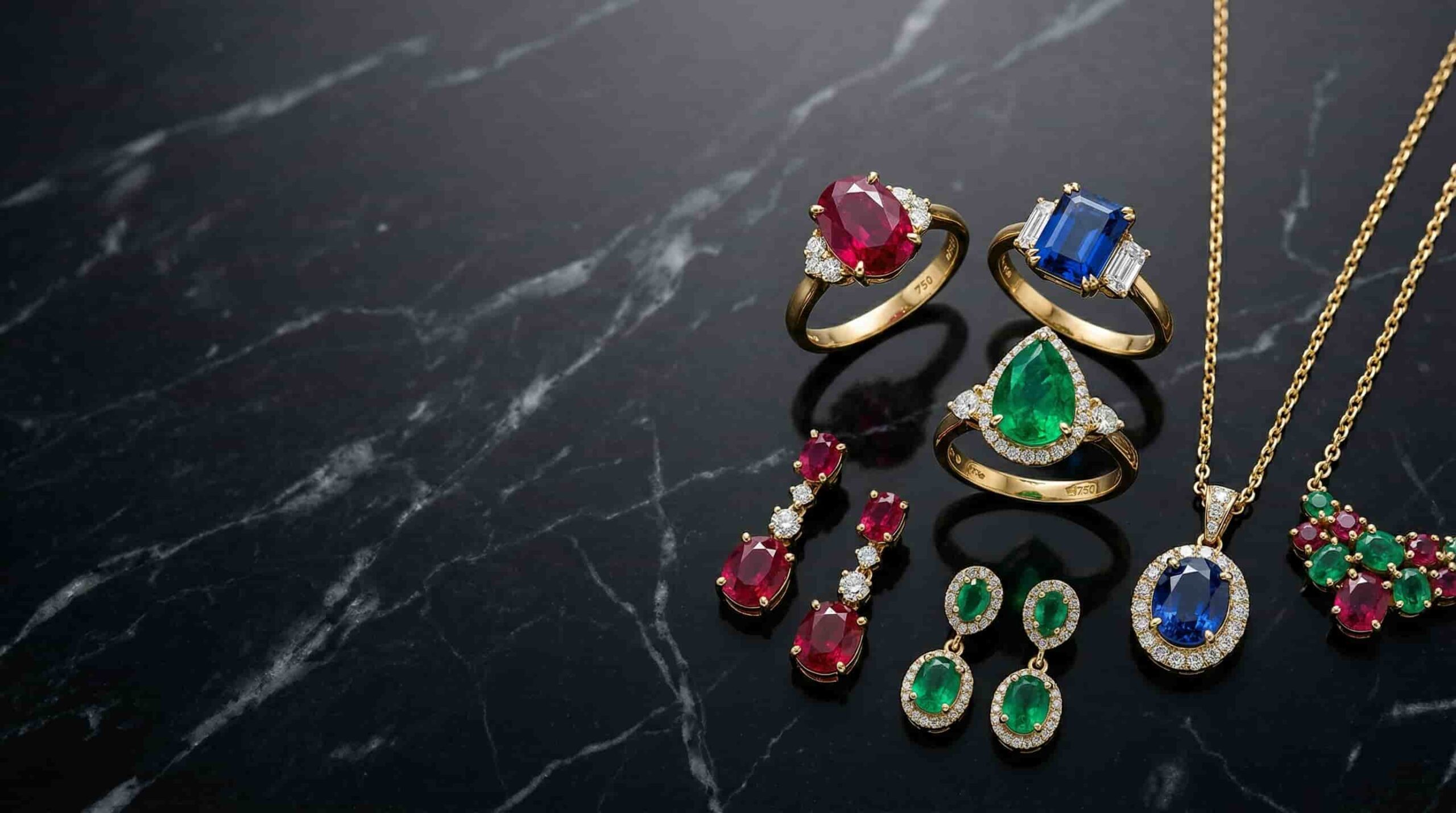
Pakistan sits at the intersection of two major gemstone supply chains: it produces Swat Valley emeralds domestically and acts as a transit hub for Afghan rubies and Burmese sapphires flowing into South Asian markets. Understanding how natural, lab-grown, and CZ (cubic zirconia) versions of these three gemstones differ in quality, price, and availability is essential for buyers in 2026.
What Are the Three Types of Ruby, Emerald, and Sapphire Available in Pakistan?
Three distinct categories of coloured gemstones are sold in Pakistan: natural mined stones, laboratory-grown stones with identical chemical composition, and simulants like cubic zirconia that share only the visual appearance.
The difference is not cosmetic. Natural rubies are corundum (Al₂O₃) with chromium inclusions. Lab-grown rubies share this exact chemical structure, produced via the Verneuil flame-fusion or hydrothermal process. CZ is zirconium dioxide (ZrO₂), a completely different material with a refractive index of 2.15 to 2.18, compared to 1.76 to 1.78 for corundum.
Natural Gemstones in Pakistan: Sources, Grades, and Pricing
Natural rubies, emeralds, and sapphires sold in Pakistan originate from 4 primary geographic sources: Afghanistan, Myanmar, Sri Lanka, and Pakistan’s own Swat Valley.
The metal setting affects the total jewellery value as much as the stone itself, read the full breakdown in Gold Plated vs Gold Filled vs Solid Gold Jewellery to understand how setting choice interacts with gemstone pricing.
Ruby Sources and Quality Grades
Rubies entering Pakistan come primarily through the Peshawar gem market, sourced from:
- Jagdalak, Afghanistan: Produces pigeon-blood rubies with strong fluorescence, typically 0.5 to 3 carats in commercial grades.
- Mogok Valley, Myanmar: Recognized by GRS (Gem Research Swisslab) as the benchmark for natural rubies; commands a 40 to 60% premium over Thai-origin stones of equal clarity.
- Mong Hsu, Myanmar: Heat-treated rubies common in mid-range Pakistani jewellery sets (3-piece gold bridal sets priced PKR 200,000 to 600,000).
Natural ruby pricing in Pakistan ranges from PKR 25,000 per carat for commercial heat-treated stones to PKR 900,000+ per carat for unheated, GRS-certified Mogok rubies.
Emerald Sources and Quality Grades
Pakistan is itself a producer of emeralds. The Swat Valley (Khyber Pakhtunkhwa province) yields emeralds with a distinct bluish-green hue rated at 6 to 7.5 on the Munsell chroma scale. The 3 quality tiers commonly traded in Lahore and Karachi markets are:
- AAA Swat emeralds: Eye-clean, vivid green, 1 to 5 carats, PKR 40,000 to 300,000 per carat
- AA grade Swat emeralds: Minor inclusions, slight yellowish secondary hue, PKR 12,000 to 40,000 per carat
- Commercial Zambian or Colombian imports: Consistent colour, heavily oiled, PKR 15,000 to 80,000 per carat
Sapphire Sources and Quality Grades
Kashmir sapphires carry the highest per-carat value of any sapphire worldwide, with certified examples traded in Pakistan’s Peshawar and Lahore markets reaching PKR 500,000 to 2,000,000+ per carat. Active mining in the Paddar region of Kashmir ended decades ago, making these stones rare auction items rather than retail stock.
The 2 sapphire types commonly available in retail:
- Ceylon (Sri Lanka) sapphires: Royal blue to cornflower blue, GIA-certified, PKR 18,000 to 350,000 per carat
- Thai heat-treated sapphires: Darker tone, widely used in silver jewellery, PKR 5,000 to 45,000 per carat
Lab-Grown Rubies, Emeralds, and Sapphires: What Pakistan’s Market Looks Like in 2026
Lab-grown corundum and beryl sold in Pakistan are chemically, optically, and physically identical to natural stones, the only difference is origin.
This distinction matters legally. The Federal Trade Commission (FTC) guidelines, adopted as a reference standard by many Pakistani gem dealers, require lab-grown stones to be disclosed at point of sale. Reputable retailers in DHA Lahore, Clifton Karachi, and Blue Area Islamabad now label lab-grown stones explicitly.
How Lab-Grown Gems Are Produced
The 3 primary production methods for lab-grown coloured stones are:
- Verneuil flame-fusion: Oldest method; produces rubies and sapphires quickly at low cost; stones show curved growth lines under 10x magnification.
- Hydrothermal synthesis: Mimics natural growth conditions; used for emeralds; produces stones with inclusions resembling natural beryl.
- Czochralski pulling method: Used for high-clarity sapphires; rarely seen in Pakistani retail but present in imported luxury jewellery.
Lab-Grown Pricing in Pakistan (2026)
Lab-grown stones trade at 85 to 95% below the price of equivalent natural stones. A 2-carat lab-grown blue sapphire with IGI certification sells for PKR 8,000 to 14,000 in Lahore gem shops, versus PKR 150,000 to 400,000 for a natural Ceylon equivalent of the same weight and clarity.
CZ Simulants: The Entry-Level Coloured Stone Market in Pakistan
Cubic zirconia simulants are not rubies, emeralds, or sapphires in any chemical sense, they are coloured zirconium dioxide stones shaped and tinted to resemble coloured gems.
CZ has a hardness of 8.0 to 8.5 on the Mohs scale versus 9.0 for corundum (ruby/sapphire) and 7.5 to 8.0 for emerald (beryl). This lower hardness means CZ scratches faster under daily wear. CZ-setNecklaces in 925 silver gold-plated settings are among the most popular pieces for nikah and engagement ceremonies in Pakistan’s mid-range market. Pakistani fashion jewellery brands, such as those operating in Anarkali Bazaar Lahore and Zainab Market Karachi, use CZ almost exclusively in silver-plated and gold-plated sets under PKR 15,000.
Key facts about CZ in Pakistan’s market:
- Over 85% of CZ simulants are imported from Guangzhou and Shenzhen, China
- A full 5-piece CZ bridal set (necklace, earrings, tikka, passa, jhoomar) retails between PKR 3,500 and 25,000
- CZ has a dispersion of 0.060, higher than diamond (0.044), producing a “rainbow fire” that experienced buyers recognise as non-gemstone
How to Tell Natural, Lab-Grown, and CZ Apart in Pakistan
4 reliable methods distinguish natural gemstones from lab-grown stones and CZ simulants without laboratory equipment:
- Chelsea filter test: Natural Colombian emeralds appear red; Zambian emeralds appear green; CZ glass appears unaffected.
- UV fluorescence: Natural Burmese rubies fluoresce strongly red under long-wave UV; Thai rubies fluoresce weakly; CZ shows no fluorescence.
- Refractive index (RI) meter: Corundum reads 1.762 to 1.770; CZ reads 2.15 to 2.18, any trained gemologist in Lahore’s GIA-affiliated labs can confirm in under 2 minutes. CZ simulants are widely used in fashion Rings sold across Pakistan, identifying them by RI meter reading takes under 2 minutes at any GIA-affiliated gem lab.
- GIA or GRS certificate verification: QR codes on GIA certificates link to a live database that confirms stone identity, treatment status, and origin.
Which Type of Gemstone Is Right for Which Buyer in Pakistan?
Buyer type determines which gemstone category delivers the best value, not personal preference alone.
- Investment buyers purchasing rubies or sapphires as assets should buy natural, unheated, GRS or GIA-certified stones above 2 carats. These retain and appreciate in value because origin and treatment status are documented.
- Bridal jewellery buyers prioritising visible size and colour over certification get the most visual value from lab-grown stones, which offer the same optical properties at 10 to 15% of the natural stone price. Browse Zuha’s Bridal Sets for 925 silver gold-plated options featuring emerald and ruby-toned CZ and lab-grown stones.
- Fashion and costume jewellery buyers who replace pieces seasonally are best served by CZ, which costs PKR 200 to 1,500 and is commercially available across all major Pakistani cities.
Where to Buy Certified Gemstones in Pakistan in 2026
Certified natural and lab-grown gemstones are available from 3 categories of verified sources in Pakistan:
- Gem dealers in Peshawar’s Shalimar Town and Namak Mandi: Primary market for rough and faceted Afghan rubies and Swat emeralds with origin certificates
- GIA-trained gemologists in DHA Lahore and Karachi: Offer third-party testing and issue local certificates aligned with international grading standards
- Online platforms (Daraz, local Instagram vendors): Sell lab-grown and CZ at transparent prices but require buyers to request seller certification before purchase
For a full breakdown of what a complete bridal set costs across gold, silver, and stone categories.
Buyers should request a written disclosure stating whether a stone is natural, lab-grown, or simulant before completing any purchase above PKR 10,000, this is standard practice in reputable Pakistani gem markets as of 2026.